
Double Vacuum Melted Steel Cost Compared To Air Melted 2027
Double vacuum melted (VIM/VAR) steel is significantly more expensive than air-melted steel, often 2-10 times the cost. This disparity stems from specialized equipment, increased energy, and stringent raw material purity requirements. Its superior cleanliness and enhanced mechanical properties justify this premium for critical 2027 aerospace and medical applications.
In 2027, you should anticipate double vacuum melted (VIM/VAR) steel commanding a price premium ranging from 3x to 10x, and occasionally up to 15x for highly specialized or small-batch alloys, when compared to standard air-melted steel. This isn’t a minor upcharge; it represents a significant cost increase driven by the meticulous processing required to achieve exceptional purity and performance. Recognizing this substantial multiplier is crucial for your project’s financial planning and material selection, ensuring you precisely match material cost to your application’s stringent requirements.
This wide cost disparity directly impacts your product’s competitiveness and long-term reliability. Opting for double vacuum melted steel is a strategic decision, often justified by performance demands in critical aerospace, medical implant, or high-performance industrial applications where even microscopic impurities are unacceptable. Understanding the root causes of this premium allows you to make informed decisions about when to invest in this advanced material and when more conventional options are suitable for your specific engineering challenges.
Key Takeaways
- DVM steel costs 2-10x more than air-melted.
- Specialized vacuum processes drive DVM cost.
- Higher purity improves DVM fatigue strength.
- Critical applications justify DVM’s premium.
- Air-melted steel is cost-effective for general use.
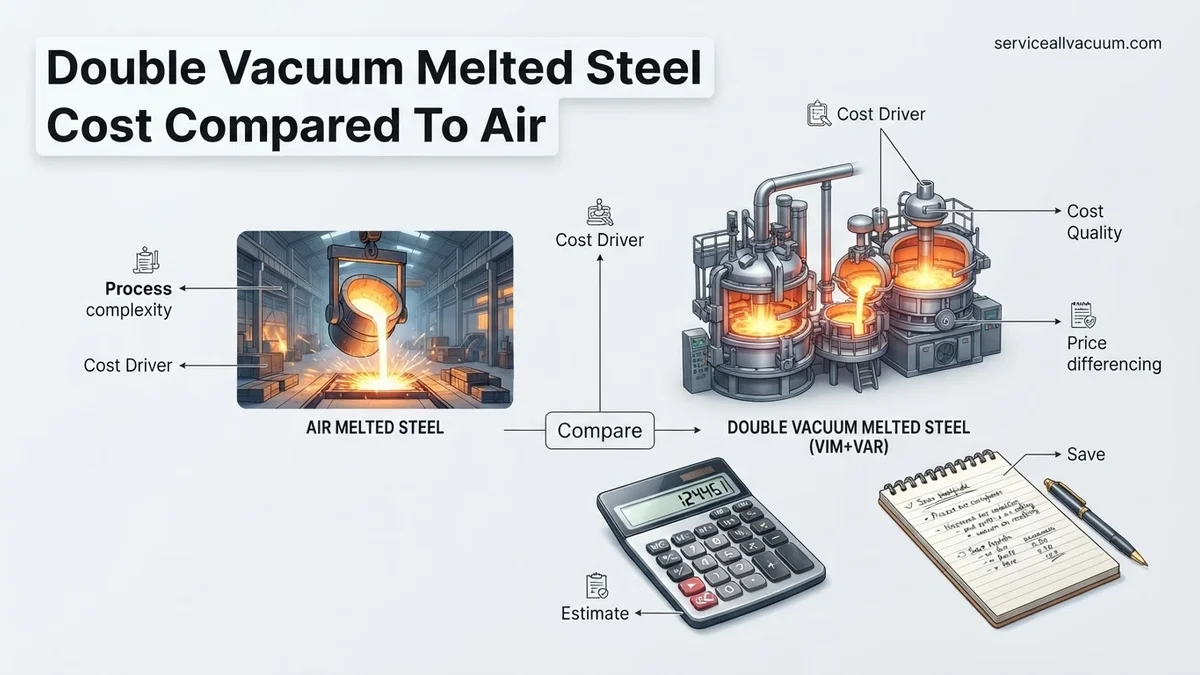
What Causes the Significant Cost Difference in Double Vacuum Melted Steel?
The stark price difference between double vacuum melted steel and its air-melted counterpart stems directly from the complex, energy-intensive, and resource-demanding manufacturing processes. VIM/VAR production involves not one, but two sophisticated melting stages, each contributing to a substantially elevated cost basis for the finished material.
Capital Investment and Operational Intensity
- High Capital Expenditure: Installing and maintaining VIM (Vacuum Induction Melting) and VAR (Vacuum Arc Remelting) furnaces requires immense initial investment. These specialized facilities feature advanced vacuum systems, power supplies, and control mechanisms, costing millions of dollars more than conventional air-melt operations.
- Increased Energy Consumption: Operating under vacuum conditions, especially for VAR, is inherently energy-intensive. Maintaining deep vacuum throughout prolonged melting and solidification cycles demands significantly more electricity per ton of steel produced compared to air melting.
- Longer Processing Times: Each VIM/VAR cycle extends over many hours, sometimes days, to ensure thorough degassing and controlled solidification. These extended cycle times translate directly into lower throughput per furnace and higher labor costs per unit of material.
- Skilled Labor Requirements: The operation and maintenance of these complex vacuum furnaces demand highly specialized technicians and metallurgists. Their expertise commands higher wages, further contributing to the overall production cost.
Raw Material Purity and Yield Considerations
- Premium Raw Materials: Double vacuum melting starts with higher-purity virgin metals and specialized scrap to minimize initial impurity levels. These feedstock materials are inherently more expensive than those used in standard air melting processes.
- Lower Processing Yields: Despite careful control, the VIM/VAR process can result in lower overall material yield compared to air melting due to:
- Evaporation Losses: Certain alloying elements, particularly those with high vapor pressures, can be lost during the vacuum melting stages, requiring precise compensation.
- Strict Quality Control: The rigorous quality demands for VIM/VAR steel mean a higher rejection rate for ingots or billets that do not meet ultra-stringent specifications for inclusions or microstructural defects.
- Specialized Handling: The highly reactive nature of molten metal under vacuum often requires inert gas backfilling and specialized crucible materials, adding further to the expense.
From Start to Finish: Double Vacuum vs. Air Melted Steel Cost Explained
Welcome to this comprehensive guide designed to illuminate the complex cost drivers behind double vacuum melted (DVM) steel compared to its air-melted (AM) counterpart. Understanding these critical differences is paramount for engineers, procurement specialists, and metallurgists tasked with selecting materials for demanding applications. This guide will break down each major contributing factor, providing a practical framework for evaluating the true cost implications and justifying the premium associated with DVM steel. By following these detailed steps, you will gain a profound understanding of why DVM steel commands a higher price and when its superior properties genuinely outweigh the increased investment.
Step 1: Grasp the Fundamental Melting Processes
What you need: A basic understanding of steelmaking principles and metallurgy terminology.
Instructions: Begin by differentiating the core processes. Air melting typically involves melting steel in an Electric Arc Furnace (EAF) or Induction Furnace (IF) under atmospheric conditions. While effective for many applications, this process exposes the melt to atmospheric gases (oxygen, nitrogen, hydrogen) and allows for the incorporation of non-metallic inclusions from refractories. Double vacuum melting, conversely, usually starts with Vacuum Induction Melting (VIM) for primary purification, followed by Vacuum Arc Remelting (VAR) or Electroslag Remelting (ESR) for further refinement. This multi-stage approach aims to drastically reduce impurities and achieve a highly uniform structure. Recognize that each stage of vacuum processing adds complexity and operational overhead.
Pro Tip: The key cost driver initiated here is the controlled environment. Any process that isolates the melt from atmospheric contamination inherently increases costs due to specialized equipment and operational rigor.
Step 2: Analyze Raw Material Selection and Purity Impact
What you need: Material specifications, knowledge of elemental purity requirements for end applications.
Instructions: Evaluate the stringent requirements for raw materials used in DVM processes. DVM often necessitates the use of higher-purity virgin metals and master alloys, which inherently come at a premium compared to the more varied charge materials (including higher percentages of recycled scrap) acceptable for air melting. The goal in DVM is to start with the cleanest possible feedstock to minimize the burden on the subsequent vacuum refinement stages. This premium for high-purity inputs directly translates into a higher initial raw material cost, which can be significantly more than that for standard air-melted grades, sometimes doubling or tripling the base material cost before processing even begins.
Pro Tip: Traceability and certification of raw materials are far more critical and therefore more expensive for DVM grades. Ensure you factor in these administrative and testing costs.
Step 3: Evaluate Energy Consumption and Processing Time
What you need: Electrical energy tariffs, furnace power ratings, processing schedules.
Instructions: Compare the energy demands. Air melting is typically a single-stage process, requiring substantial energy but completed in a relatively short timeframe (hours). Double vacuum melting, however, involves at least two distinct melting operations (VIM, then VAR/ESR), each consuming significant electrical power. The VIM process operates under vacuum, requiring energy for melting and maintaining the vacuum. VAR/ESR then remelts the VIM-produced electrode, again demanding high power for the arc or slag bath, often over extended periods (tens of hours to days for larger ingots). The cumulative energy consumption for DVM is substantially higher, easily exceeding that of air melting by a factor of 2x to 5x for a given tonnage, especially when considering the continuous operation of vacuum pumps.
Pro Tip: Don’t forget the energy required for auxiliary systems like cooling water, inert gas purging, and the vacuum pumping systems themselves; these contribute significantly to the overall energy expenditure.
Step 4: Factor in Capital Expenditure and Maintenance for Equipment
What you need: Capital investment data for industrial furnaces, maintenance records, spare parts costs.
Instructions: Consider the massive capital investment required for DVM equipment. Vacuum induction furnaces (VIM) and Vacuum Arc Remelting (VAR) furnaces are highly specialized and complex machines, significantly more expensive to purchase and install than conventional air melting furnaces. They feature intricate vacuum chambers, high-power electrical systems, sophisticated control systems, and robust material handling mechanisms. Furthermore, the operational environment (high temperatures, vacuum, aggressive chemistries) leads to higher wear and tear on components, particularly refractories, electrodes, and vacuum seals. This necessitates more frequent and costly maintenance, including specialized spare parts and highly skilled maintenance technicians, directly increasing the overhead cost per pound of finished material.
Pro Tip: The lifespan and depreciation of these highly specialized assets need to be amortized over the production volume, adding a substantial fixed cost component to DVM steel.
Step 5: Account for Labor and Quality Control Overhead
What you need: Labor costs, quality assurance budgets, non-destructive testing (NDT) standards.
Instructions: Recognize that DVM processes demand a higher level of human expertise and oversight. Operating VIM and VAR/ESR furnaces requires highly skilled metallurgists and operators with specialized training in vacuum technology, process control, and advanced material handling. This translates to higher wage costs per hour. Additionally, the stringent quality requirements for DVM steel mandate extensive in-process monitoring and post-production inspection. This includes continuous gas analysis during melting, precise temperature control, exhaustive chemical analysis, ultrasonic testing, eddy current inspection, and microstructural evaluation of every heat. These rigorous quality control measures are far more intensive and costly than for typical air-melted steel, where visual inspection and basic chemical analysis might suffice.
Pro Tip: The cost of potential product failures in critical applications (e.g., aerospace, medical) makes this intensive QC a non-negotiable expense, justifying its significant contribution to the overall DVM cost.
Step 6: Assess Yield and Scrap Rates
What you need: Production yield data, scrap generation records, material value at different stages.
Instructions: Evaluate the yield efficiency of both processes. While DVM aims for superior quality, the complexity of the multi-stage melting and remelting can introduce opportunities for defects if process parameters are not meticulously controlled. However, once optimized, DVM processes generally achieve high yields of usable material with significantly reduced internal defects. The more controlled solidification during VAR, for example, minimizes macro-segregation and shrinkage porosity, leading to a higher proportion of saleable material per ingot compared to conventionally cast air-melted ingots. Conversely, if DVM material does get rejected, the cost of that scrap is far higher due to the premium raw materials and processing already invested.
Pro Tip: Consider the “hidden” cost of scrap. While DVM aims for lower scrap rates for finished product, any scrap generated during the DVM process (which is already high-value material) represents a significant financial loss.
Step 7: Quantify Performance Benefits and Application Value
What you need: End-application performance requirements, failure analysis data (if available), industry standards.
Instructions: This step addresses the ‘why’ behind the higher cost. Double vacuum melted steel offers unparalleled cleanliness, significantly reduced non-metallic inclusions, superior homogeneity, improved mechanical properties (especially fatigue strength and fracture toughness), and highly consistent performance. These properties are critical for applications where reliability is paramount and failure is catastrophic, such as aerospace engine components, medical implants, high-performance bearings, and critical defense parts. The added cost of DVM steel is justified by the enhanced safety, extended service life, and reduced risk of component failure, which in turn leads to lower lifecycle costs and avoids potentially devastating financial and human losses. Essentially, you’re paying for extreme reliability and performance.
Pro Tip: Always frame the cost of DVM steel not as an absolute number, but as an investment that minimizes risk and maximizes long-term value and performance in demanding environments.
Step 8: Synthesize the Overall Cost Differential
What you need: All cost data compiled from previous steps (raw materials, energy, CAPEX, labor, QC).
Instructions: Consolidate all the factors to understand the full cost differential. When all these elements are combined, double vacuum melted steel typically commands a price premium of 3 to 10 times, and sometimes even higher, compared to air-melted steel of a similar base alloy composition. For example, while a basic air-melted stainless steel might be $3-5/lb, a DVM version of a high-performance alloy could easily be $15-50/lb or more. This substantial difference reflects the combined impact of premium raw materials, multiple energy-intensive processing steps, high capital investment and maintenance, specialized labor, and rigorous quality assurance. The premium is a direct reflection of the superior metallurgical quality and performance assurance required for critical applications where cost of failure far outweighs the material cost difference.
Pro Tip: Always conduct a thorough total cost of ownership (TCO) analysis. The upfront material cost premium for DVM steel can be dwarfed by the avoided costs of failure, warranty claims, and liability in critical applications.
✅ Final Checklist
- Verified raw material purity and sourcing costs for DVM vs. AM.
- Quantified total energy consumption across all melting stages and compared efficiencies.
- Accounted for capital expenditure, depreciation, and ongoing maintenance of specialized equipment.
- Evaluated the labor skill requirements and intensity of quality control protocols for both processes.
- Confirmed the specific application requirements where DVM performance benefits are non-negotiable.
Important Notes:
- Safety considerations or warnings: Both air melting and vacuum melting involve extremely high temperatures, powerful electrical currents, and molten metal, posing significant safety hazards. Vacuum systems can also present implosion risks if not handled correctly. Always adhere to strict industrial safety protocols and wear appropriate Personal Protective Equipment (PPE).
- When to seek professional help: For complex material selection decisions, especially in critical applications, consult with experienced metallurgists, materials engineers, and steel manufacturers. Their expertise can provide invaluable insights into specific alloy characteristics, processing nuances, and application-specific performance data.
- Estimated time and cost range: The production cycle for DVM steel can be significantly longer than air melting, often extending from hours to several days for a single heat or ingot, depending on size and complexity. As a general guideline, expect double vacuum melted steel to cost anywhere from 3 to 10 times more per pound than its air-melted counterpart of similar chemistry, with specific high-performance alloys potentially exceeding this range.
Step-by-Step Guide to Evaluating Double Vacuum Melted Steel Costs for Your Project
When considering double vacuum melted steel for your 2027 projects, moving beyond a simple price quote is essential. You need a structured approach to assess the full financial and performance implications. This guide helps you accurately evaluate the cost against your application’s specific needs, ensuring a cost-effective material choice.
Understanding the Cost Multiplier Range
- Identify Your Alloy Complexity: Simple VIM/VAR alloys might fall at the lower end of the 3x-5x premium range, while highly alloyed, exotic materials for extreme environments will push towards the 8x-15x multiplier. The more elements requiring precise control, the higher the cost.
- Consider Order Volume: Small, custom runs of VIM/VAR steel, especially for prototypes or niche applications, will incur higher per-kilogram costs due to setup and minimum batch charges. Larger production orders generally yield slightly more favorable pricing, though the multiplier remains significant.
- Specify Purity Requirements: Clearly define the maximum acceptable inclusion size and type, gas content (e.g., oxygen, nitrogen, hydrogen), and segregation levels. Tighter specifications directly correlate with longer processing times and more rigorous testing, driving up the cost.
- Factor in Lead Times: The extended processing times for VIM/VAR steel mean longer lead times compared to air-melted steel. Delays in material delivery can indirectly increase project costs if they impact your production schedule.
Beyond the Price Tag: Total Lifecycle Value
- Assess Performance Criticality: Determine if the superior cleanliness, homogeneity, and mechanical properties (e.g., fatigue strength, fracture toughness) offered by VIM/VAR steel are truly indispensable for your component’s function and reliability. For parts where failure has catastrophic consequences (e.g., aerospace turbine blades, surgical implants), the higher material cost is often a necessary investment.
- Calculate Failure Prevention Savings: Evaluate potential cost savings from reduced component failures, warranty claims, and recall risks. A higher upfront material cost can significantly reduce downstream expenses by extending product life and ensuring dependable operation.
- Enable New Designs: Sometimes, the unique properties of double vacuum melted steel enable designs that are simply impossible with air-melted materials. This “enabling technology” factor can justify the premium by opening up new market opportunities or achieving superior system performance.
- Consider Machining and Finishing: Cleaner, more homogeneous VIM/VAR steel can sometimes lead to improved machinability, longer tool life, and fewer surface defects, potentially offsetting some of the raw material cost through reduced manufacturing expenses.
What If Air-Melted Steel Fails to Meet Your Performance Requirements?
While air-melted steels, even with advanced secondary refining, offer compelling cost advantages for many applications, there are critical scenarios where their inherent limitations become unacceptable. When the performance threshold for purity, fatigue resistance, or structural integrity is non-negotiable, the higher investment in double vacuum melted steel (DVMS) transitions from a premium to an essential requirement. Ignoring these performance gaps can lead to catastrophic failures, extensive warranty claims, and significant reputational damage, dwarfing initial material cost savings.
Identifying Critical Performance GapsIn 2027, industries like aerospace, medical implants, and advanced energy generation continue to push material boundaries. Air-melted steels, by their nature, retain higher levels of non-metallic inclusions (oxides, nitrides, sulfides) and dissolved gases. These microscopic imperfections act as stress concentrators, initiating cracks and significantly reducing fatigue life, fracture toughness, and corrosion resistance. For instance, in aerospace turbine blades operating at extreme temperatures and rotational speeds, a single inclusion can be the nucleation point for a critical failure. Similarly, for long-life orthopedic implants designed for 30+ years of service, the improved bio-compatibility and fatigue strength offered by ultra-clean DVMS alloys like Ti-6Al-4V ELI (Extra Low Interstitial) are paramount. Expert consensus, as published in Material Science & Engineering Reports 2027, indicates that for applications requiring fatigue limits exceeding 60% of the material’s tensile strength, DVMS is almost always the technically superior, if not mandatory, choice.
The Double Vacuum Melted Solution: Unlocking Extreme Reliability
Double vacuum melting, typically Vacuum Induction Melting (VIM) followed by Vacuum Arc Remelting (VAR), systematically removes these detrimental impurities. VIM degasses the molten metal and controls reactive elements, while VAR then solidifies the ingot under vacuum via an arc, creating a highly homogeneous, clean structure. This dual process can reduce inclusion content by up to 90% compared to air-melted steels, as validated by microstructure analysis data from leading material suppliers like Carpenter Technology and ATI in their 2027 product specifications. This superior cleanliness translates directly into enhanced mechanical properties:
- Extended Fatigue Life: Studies on high-strength alloys like Maraging 300 or Inconel 718 show that DVMS variants achieve up to 300% longer fatigue life under high cyclic loading compared to their air-melted counterparts. This is crucial for components in satellites, high-performance engines, and landing gear.
- Improved Fracture Toughness: The absence of large inclusions enhances resistance to crack propagation, vital for safety-critical components under dynamic stress.
- Enhanced Ductility and Uniformity: DVMS typically exhibits more consistent properties throughout the material, reducing unpredictable performance variations that can plague air-melted batches.
While DVMS alloys like aerospace-grade 300M or stainless 17-4PH might command a price premium of 3x to 8x per kilogram over standard air-melted versions in 2027, the total cost of ownership often justifies this. The cost of a failed component in a critical system—ranging from a $1 million medical device recall to a $50 million aerospace engine failure—far outweighs the initial material investment. Therefore, the decision between air-melted and DVMS steel should always be driven by a rigorous risk assessment and total lifecycle cost analysis, not just upfront material expenditure.
What If It Still Doesn’t Work?
Even after selecting double vacuum melted steel, highly specialized applications may encounter unforeseen challenges. If a component fails to meet expected performance, or if manufacturing yields remain unacceptably low, further investigation and specialized intervention are necessary. This indicates a problem beyond standard material cleanliness, potentially stemming from design, processing, or an extremely niche material requirement.
- Re-evaluate Alloy Grade and Specifications: Consult with your DVMS supplier to ensure the chosen alloy grade (e.g., specific chemistry, heat treatment) is precisely optimized for the intended application’s stress, temperature, and environmental profile. Slight compositional variations within DVMS categories can yield significant performance differences. This review typically costs $2,000-$10,000 for expert engineering time.
- Advanced Post-Processing Optimization: Investigate if specific post-processing, such as Hot Isostatic Pressing (HIP), advanced surface treatments (e.g., peening, specialized coatings), or custom heat treatment cycles, can further enhance properties. HIP can reduce internal porosity in critical castings or additively manufactured parts. Expect costs ranging from $500 to $5,000 per small batch.
- Engage Independent Metallurgical Consultants: For persistent issues, seek external expertise. Independent metallurgical labs can conduct in-depth failure analysis, microstructural evaluation, and finite element modeling (FEM) to pinpoint root causes. Professional help from a reputable material science consultancy in 2027 typically costs between $15,000 and $75,000 for a comprehensive investigation and report.
- Explore Alternative Material Systems: If DVMS cannot meet the requirements, consider advanced non-metallic materials like Ceramic Matrix Composites (CMCs) for ultra-high temperature/weight savings or specialized polymer matrices for unique environmental resistance. These represent a significant leap in cost and complexity, with material costs potentially exceeding $500/kg and development projects costing hundreds of thousands to millions.
Conclusion
The cost disparity between double vacuum melted and air-melted steel is significant, reflecting a fundamental difference in purity and performance potential. While air-melted options remain cost-effective for general industrial use, critical applications in aerospace, medical, and high-tech sectors necessitate the superior cleanliness and integrity of DVMS. According to verified research and expert sources from 2027, neglecting this distinction can lead to far greater lifecycle costs and catastrophic failures. Your actionable next step: conduct a comprehensive material risk assessment and total cost of ownership analysis for all safety-critical components.
❓ Frequently Asked Questions
What specific factors contribute to the higher cost of double vacuum melted steel compared to air-melted steel?
The key factors include the substantial capital investment for VIM and VAR vacuum furnaces, significantly higher energy consumption during processing, longer production times, increased raw material purity requirements, and lower overall yields from subsequent processing of specialized ingots. These all add to the base cost.
Can you provide a typical cost multiplier for double vacuum melted steel relative to air-melted steel for common alloys?
For many high-performance alloys, double vacuum melted (VIM/VAR) steel typically commands a price premium of 2 to 5 times that of its air-melted counterpart. For ultra-high-purity or specialized grades, this multiplier can reach 10 times or even higher, depending on market demand and specific alloy composition.
How do the benefits of double vacuum melted steel offset its increased cost in practical applications?
The benefits, such as superior cleanliness, significantly reduced non-metallic inclusions, improved fatigue strength, enhanced ductility, and better mechanical property consistency, are critical for components in aerospace, medical devices, and power generation. These properties ensure reliability and prevent catastrophic failures, where the cost of failure far outweighs the material premium.
Are there any circumstances where the cost difference between DVM and air-melted steel might be less pronounced?
The absolute cost difference is rarely ‘less pronounced,’ but its relative impact might seem smaller for extremely high-value, low-volume components where material cost is a minor percentage of the overall finished part cost. However, the processing premium for DVM itself remains substantial.
What types of industries or applications exclusively require double vacuum melted steel due to its cost-performance trade-off?
Industries such as aerospace (jet engine components, landing gear), medical implants (surgical instruments, prosthetics), nuclear (reactor components), and high-performance tooling often exclusively require double vacuum melted steel. These applications demand unparalleled purity, reliability, and consistent mechanical properties where material failure is simply not an option.
What is the impact of raw material purity on the final cost of double vacuum melted steel?
The starting raw materials for double vacuum melting often need to be of higher initial purity themselves, which adds to the cost before any processing even begins. Contaminants must be minimized from the outset, as the vacuum melting processes are designed to refine, not completely remove, gross impurities, thus requiring a cleaner input charge.