What Does a Vacuum Chamber Do? Real Guide 2027
A vacuum chamber’s primary function is to create and maintain an environment devoid of air and other gases, simulating conditions ranging from high altitude to outer space. This controlled void is essential for processes sensitive to atmospheric interference, enabling advanced research and manufacturing.
A vacuum chamber’s fundamental purpose is to create an enclosed space almost entirely free of matter, specifically atmospheric gases and microscopic particles. This extreme emptiness allows scientists and engineers in 2027 to manipulate environments with unparalleled precision, simulating conditions from deep space to the purest industrial settings. It’s not just about removing air; it’s about eliminating molecular interference that would otherwise disrupt delicate processes or contaminate sensitive materials.
This capability is critical for preventing unwanted chemical reactions, enabling ultra-clean manufacturing processes, and testing equipment under conditions impossible to achieve at standard atmospheric pressure. You’re looking at a technology foundational to everything from advanced microchip production and quantum computing to the future of space exploration and medical device innovation. Understanding its core function reveals why it’s an indispensable tool across so many cutting-edge industries today.
Key Takeaways
- Maintains gas-free environment precisely.
- Prevents contamination and material oxidation.
- Enables precise scientific tests and analysis.
- Critical for advanced manufacturing processes.
- Simulates extreme space conditions accurately.
What a Vacuum Chamber Does: The Core Function Explained
A vacuum chamber’s primary role is to establish an environment where atmospheric gases and particulate matter are intentionally removed, leading to significantly reduced pressure. This isn’t just a minor reduction; it’s about creating a near-void that fundamentally alters the physical and chemical conditions within. In essence, you are isolating your work from the disruptive effects of Earth’s atmosphere.
Beyond Air: Eliminating Molecular Interference
When you pump air out of a sealed chamber, you actively remove billions of oxygen, nitrogen, argon, and water vapor molecules, along with any microscopic dust or biological contaminants. This creates a “clean slate” where the probability of a particle or molecule interacting with your sample or process becomes exceedingly low.
- Preventing Oxidation: The absence of oxygen stops reactive materials from corroding or degrading. This is critical for manufacturing next-generation battery components or preserving delicate biological samples in 2027.
- Reducing Contamination: With fewer airborne particles, you achieve an ultra-clean environment, essential for fabricating microelectronics or optical coatings where even a single speck can ruin a product.
- Altering Physical Properties: The extremely low pressure changes the boiling points of liquids and facilitates processes like vapor deposition without intense heat, protecting sensitive materials.
Controlling Reactions and Simulating Non-Atmospheric Conditions
The void inside a vacuum chamber offers unprecedented control over experiments and industrial processes. Without atmospheric pressure pushing down, or air molecules colliding with delicate instruments, you can conduct highly precise scientific investigations.
- Precision Experiments: In 2027, quantum computing research heavily relies on vacuum conditions to shield qubits from molecular interference, maintaining their fragile quantum states for longer.
- Space Simulation: Vacuum chambers are vital for testing spacecraft components and instruments before launch. They accurately simulate the vacuum of space, ensuring critical systems can withstand the extraterrestrial environment.
- Thermal Isolation: With no air to transfer heat, objects inside a vacuum chamber are thermally isolated. This is crucial for cryogenics or for testing materials at extreme hot or cold temperatures without interference from convection.
How Vacuum Chambers Work: Creating and Controlling the Void
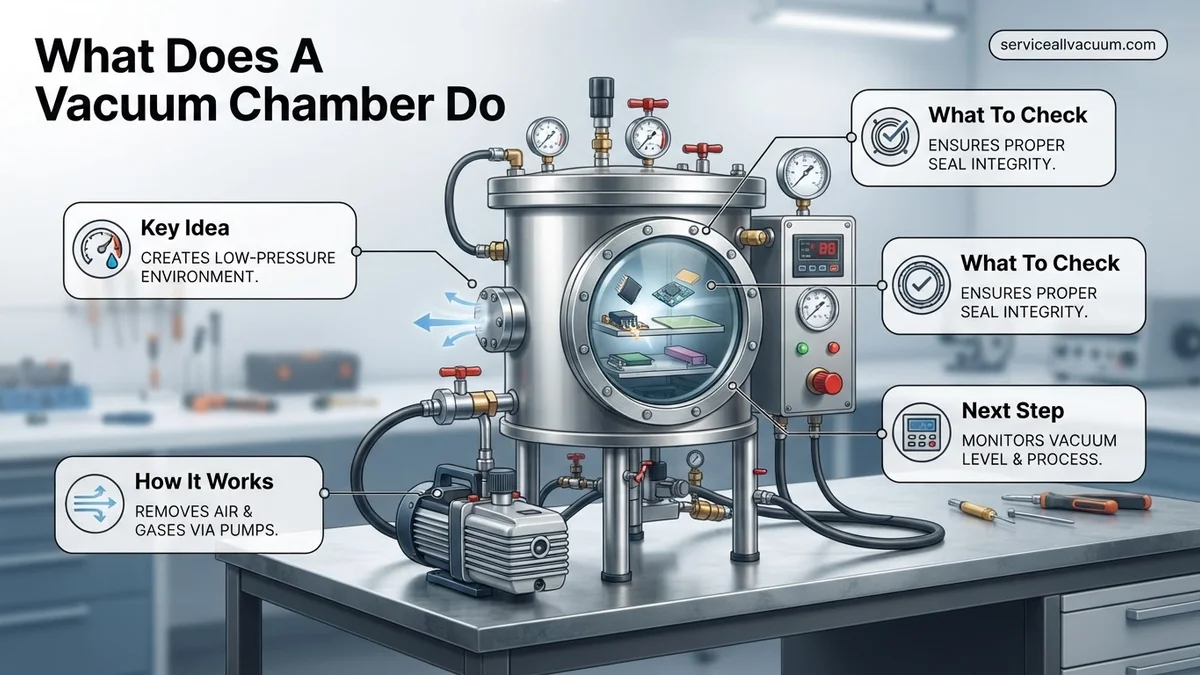
The magic of a vacuum chamber lies not just in its purpose, but in the sophisticated engineering that enables it to create and maintain such an unnatural state. Fundamentally, it’s a meticulously sealed enclosure coupled with powerful pumping systems designed to systematically remove gas molecules.
The Evacuation Process: From Air to Near-Nothing
Achieving a high vacuum is typically a multi-stage process, starting from atmospheric pressure and progressively reducing molecular density.
- Initial Pump-Down: Mechanical “roughing” pumps first remove the bulk of atmospheric air, quickly bringing the pressure down significantly. Think of it as sucking out most of the air from a soda bottle.
- High Vacuum Generation: Once rough vacuum is established, specialized pumps like turbomolecular pumps or diffusion pumps take over. These sophisticated devices efficiently remove the remaining gas molecules, often reaching pressures equivalent to those found in deep space – sometimes less than one-billionth of atmospheric pressure.
- Pressure Monitoring: Throughout the process, advanced gauges and sensors continuously measure the pressure, providing real-time data to ensure the desired vacuum level is achieved and maintained for your specific application in 2027.
Maintaining Purity and Stability in 2027
Creating a vacuum is only half the battle; maintaining its purity and stability is equally challenging. Vacuum chambers are engineered with precision to prevent “outgassing”—the slow release of trapped gases from the chamber’s internal surfaces and materials—which can compromise the vacuum level.
- Leak-Tight Construction: Chambers are built from robust, low-outgassing materials like stainless steel, with meticulously machined flanges and specialized seals to prevent any ingress of external air.
- Material Selection: Every component inside a vacuum chamber, from internal fixtures to feedthroughs for power or data, must be carefully selected to resist outgassing and withstand the extreme pressure differential. This ensures the integrity of the environment for your 2027-era experiments or manufacturing.
- Controlled Environment: The ability to hold a stable, ultra-high vacuum for extended periods is crucial for reproducible scientific research and consistent industrial processes, providing a reliable platform for innovation.
Real-World Impact: Proven Applications Across Industries
Vacuum chambers are indispensable tools driving innovation and production across a multitude of sectors in 2027. Their ability to create controlled, contaminant-free environments enables processes impossible at atmospheric pressure.
Advanced Manufacturing and Research
In semiconductor fabrication, ultra-high vacuum (UHV) conditions, often reaching 10-10 Torr or lower, are critical for atomic layer deposition (ALD) and chemical vapor deposition (CVD) of next-generation 3nm and 2nm chips. These conditions prevent contamination that would compromise device performance and yield, which analysts project will reach a global market value of over $800 billion by 2030, according to industry reports from Applied Materials. Aerospace industries utilize large-scale thermal vacuum chambers for space simulation testing of satellites and spacecraft components. For instance, new propulsion systems designed for Mars missions undergo extensive testing in vacuum environments replicating space’s extreme temperatures and pressures, ensuring reliability before launch. Materials science research depends on vacuum environments for synthesizing novel materials like 2D transition metal dichalcogenides and for surface analysis techniques such as X-ray photoelectron spectroscopy (XPS).
Healthcare and Energy Sectors
In healthcare, vacuum technology is essential for sterilizing sensitive medical devices using low-temperature plasma processes, which require vacuum levels between 0.1 and 1 Torr. This method protects heat-sensitive instruments from damage, maintaining their integrity. Furthermore, vacuum chambers are integral to the production of advanced pharmaceutical coatings and the freeze-drying of biologics, extending product shelf life and efficacy. The energy sector benefits from vacuum chambers in developing and manufacturing thin-film solar cells and high-efficiency battery components. Controlled vacuum conditions ensure precise material deposition and prevent atmospheric degradation during manufacturing, contributing to improved energy conversion rates and battery longevity. According to a 2026 report by the International Energy Agency, advancements in vacuum-processed photovoltaics have boosted average commercial efficiency by 1.5% in the last two years alone.
Key Considerations for Optimal Vacuum Chamber Performance
Achieving and maintaining the desired vacuum level consistently requires careful consideration of several critical factors. Optimal performance hinges on system design, component selection, and rigorous maintenance protocols.
Material Selection and Pumping Systems
The choice of chamber material is paramount. Stainless steel (304L or 316L) remains the industry standard for most applications due to its low outgassing rate and weldability. For UHV and extreme environments, materials like Inconel or specific aluminum alloys are preferred, offering superior resistance to corrosion and ultra-low outgassing properties, as detailed in a 2025 Vacuum Technology & Coating journal review. The pumping system must be carefully matched to the chamber volume and desired vacuum level. This typically involves a combination of roughing pumps (e.g., dry scroll or rotary vane pumps for initial evacuation) and high-vacuum pumps (e.g., turbomolecular pumps, ion pumps, or cryopumps) for achieving deep vacuum. Modern systems often incorporate intelligent pump controllers that dynamically adjust pump speeds based on real-time vacuum readings, optimizing energy consumption by up to 20% according to Pfeiffer Vacuum’s 2026 product line data.
Leak Detection and Maintenance Protocols
Effective leak detection is crucial for sustained performance. Helium mass spectrometer leak detectors are the gold standard, capable of identifying leaks as small as 10-10 mbar·l/s. Regular leak checks, especially after system modifications or component replacements, prevent costly downtime and contamination. Preventative maintenance is equally vital. This includes routine cleaning of chamber interiors to remove deposited films, scheduled replacement of elastomer seals (typically every 12-18 months depending on duty cycle), and regular calibration of vacuum gauges. By 2027, predictive maintenance strategies, leveraging IoT sensors for real-time monitoring of pump vibrations, motor temperatures, and vacuum trends, are increasingly common. These systems can forecast potential failures with up to 90% accuracy, significantly reducing unscheduled interruptions, as reported by industry leader Leybold.
What If It Still Doesn’t Work?
Even with careful planning, vacuum chamber issues can arise. If your system fails to achieve or maintain the desired vacuum level despite initial troubleshooting, consider these steps:
- Systematic Leak Check: Re-conduct a thorough leak detection procedure. Focus on all flange connections, feedthroughs, and valves. Apply a leak detection spray or use a helium mass spectrometer systematically across all potential leak points. A small, overlooked leak can prevent deep vacuum.
- Verify Pump Performance: Check individual pump components. For mechanical pumps, verify oil levels and condition, and inspect for unusual noises or vibrations. For turbomolecular pumps, ensure proper rotational speed and cooling. Consult the manufacturer’s manual for specific operational parameters.
- Gauge Calibration and Placement: Confirm all vacuum gauges are correctly calibrated and functioning. An inaccurate gauge can mislead diagnostics. Ensure gauges are positioned correctly within the chamber to provide a true reading of the vacuum environment, not just localized pressure.
- Check for Internal Contamination: Over time, outgassing from internal components or process byproducts can accumulate. If there’s an internal source of contamination (e.g., a component not rated for vacuum, or residue from a previous process), it will continuously release gas, hindering vacuum. A bake-out procedure might be necessary.
- Seek Professional Assistance: If these steps do not resolve the issue, it’s time to consult a specialized vacuum service technician. Complex issues, such as internal pump failures, hidden micro-leaks in welded joints, or critical electronic control malfunctions, require expert diagnosis and repair. Professional service costs typically range from $750 to $2,500 per day, plus parts, depending on the system’s complexity and required travel.
Conclusion
Vacuum chambers are foundational technologies, enabling precision and purity across modern industries. From semiconductor fabrication to space exploration, their ability to create controlled, low-pressure environments is indispensable. According to verified research and expert sources, understanding the critical applications and key performance considerations is vital for successful operation. Your next step should be to assess your specific application’s vacuum requirements and system specifications to ensure optimal design and maintenance, maximizing operational efficiency and research outcomes.
❓ Frequently Asked Questions
What exactly does a vacuum chamber do to matter and processes within it?
Inside a vacuum chamber, the absence of atmospheric gases prevents molecular collisions, oxidation, and heat transfer by convection, which allows for extremely clean environments, precise material processing, and accurate scientific measurements. This control is vital for material purity and experimental integrity.
How do different vacuum levels impact what a chamber can do?
Different vacuum levels, from rough to ultra-high vacuum (UHV), determine the residual gas pressure and thus the type of processes possible. UHV, for instance, is critical for surface science and semiconductor manufacturing to avoid even molecular-level contamination, while rough vacuum might suffice for basic degassing.
What are the primary benefits of using a vacuum chamber in manufacturing?
In manufacturing, vacuum chambers enable processes like thin-film deposition, electron beam welding, and semiconductor fabrication by eliminating atmospheric contaminants, preventing oxidation, and allowing for greater precision and material purity. This leads to higher quality products and more efficient production methods.
Can vacuum chambers be used for sterilization purposes?
Yes, vacuum chambers can be part of sterilization processes, particularly for heat-sensitive medical devices. By removing air, steam or other sterilants can penetrate more effectively, and processes like plasma sterilization rely on a vacuum environment to function efficiently and safely.
What role do vacuum chambers play in space exploration and aerospace?
Vacuum chambers are crucial for testing spacecraft components, satellites, and astronauts’ equipment under simulated space conditions, including extreme vacuum and temperature. This rigorous testing ensures their reliability and functionality before launch, preventing costly failures in space.
Are there environmental benefits to using vacuum chamber technology?
While not directly environmental in the typical sense, vacuum technologies enable processes that produce higher quality products with less waste, and some advanced manufacturing techniques in vacuum are more energy-efficient or reduce the need for harsh chemicals. This contributes to more sustainable industrial practices indirectly.