What is a Wet and Dry Vacuum? An Expert 2027 Guide
A wet and dry vacuum is a versatile cleaning tool designed to tackle both liquid spills and solid debris effectively. Unlike standard vacuums, it features a specialized motor and filtration system that allows it to safely pick up water, sludge, and other fluids without damage. This dual functionality makes it indispensable for workshops, garages, and emergency cleanups.
A wet and dry vacuum, often called a shop vac, stands as an incredibly versatile cleaning powerhouse unlike any standard household vacuum you own. Engineered to tackle both solid debris and liquids with equal, robust proficiency, it’s the ultimate tool for demanding cleanup tasks. In 2027, understanding this dual capability is critical for anyone managing a workshop, dealing with home renovation projects, or preparing for unexpected spills, making it an indispensable asset that saves time, effort, and prevents costly damage.
Unlike conventional dry-only vacuums, which would instantly seize up or short-circuit if they encountered water, a wet and dry vacuum is purpose-built for that challenge. It represents a fundamental shift in cleaning technology, offering you the power to swiftly clear everything from sawdust and screws to standing water and sludge without a second thought. This article will thoroughly explain what sets these machines apart, their clever internal workings, and why they are essential for particular applications.
Key Takeaways
- Picks up both liquids and solids safely.
- Bypass motor prevents electrical damage.
- Essential for workshops and spills.
- Requires specific filters for wet vs. dry.
- Offers versatile cleaning power.
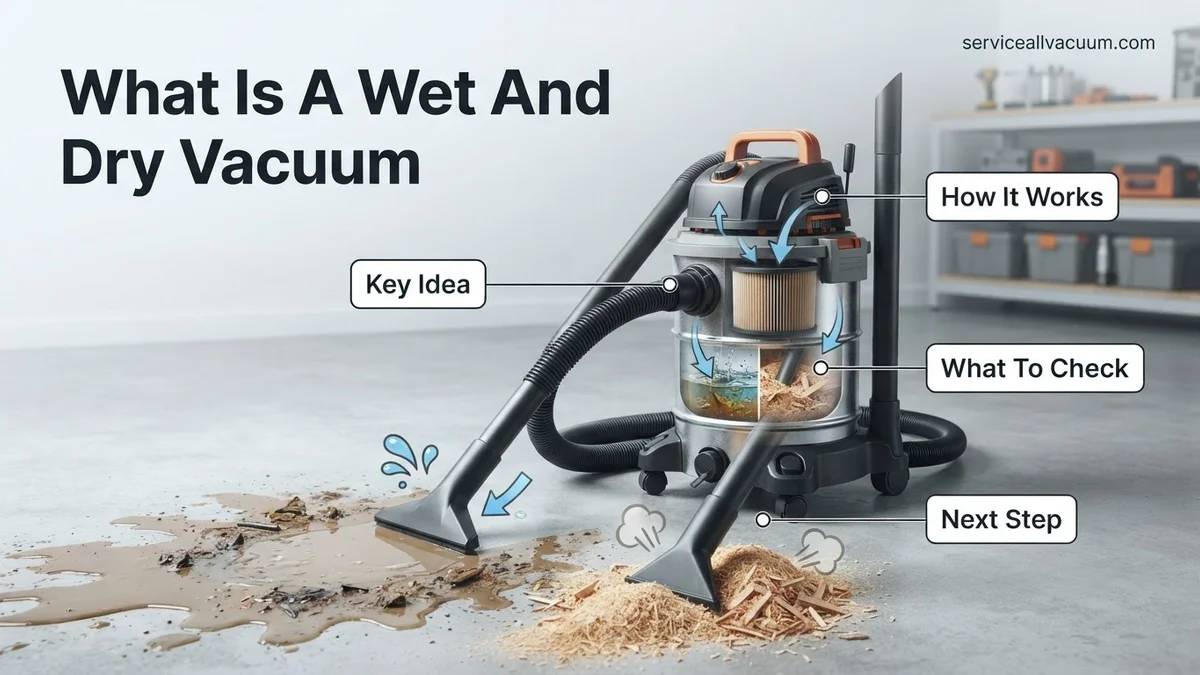
Diagnosing the Dual-Purpose Cleaner: What is a Wet and Dry Vacuum?
At its core, a wet and dry vacuum is a heavy-duty appliance engineered specifically to suction up both dry particulates and various liquids with powerful efficacy. Forget the delicate nature of your upright home vacuum; these units are designed for resilience and raw cleaning power. They excel where traditional vacuums fail, managing everything from fine dust and construction debris to spilled beverages, clogged sink overflows, or basement leaks. The crucial distinction lies in their ability to transition seamlessly between collecting solids and liquids without compromise.
The Core Distinction: Beyond Dry Debris
A standard dry-only vacuum relies on a continuous airflow path directly through its motor for cooling, and its filtration system is exclusively tailored for dry particles. Introducing any liquid into such a system would inevitably lead to motor damage, filter saturation, and potential electrical hazards. A wet and dry vacuum, by contrast, is internally constructed to bypass these vulnerabilities. It offers a sealed environment for liquids, ensuring they never come into contact with electrical components, and incorporates a flexible filtration system that adapts to the task. This dual functionality is not an add-on; it’s fundamental to its very design, allowing you to tackle truly messy situations with confidence.
Built for Resilience: Key Design Elements
You’ll immediately recognize a wet and dry vacuum by its robust, no-nonsense construction. Unlike the sleek, often delicate plastics of residential vacuums, these machines feature durable, impact-resistant plastic or sturdy metal tanks designed to withstand harsh environments. These collection tanks are typically much larger than those found on domestic vacuums, holding significant volumes of liquid or accumulated dry debris, which drastically reduces the frequency of emptying. Furthermore, the accompanying hoses are wider and more flexible, less prone to clogging from larger items. Specialized nozzles and attachments, such as squeegee tools for water pickup or crevice tools designed to grab larger pieces of debris, further enhance its practical capabilities, making it a true workhorse for any challenging cleanup.
How Wet and Dry Vacuums Work: The Mechanism Explained
The ingenuity behind a wet and dry vacuum lies in its fundamental design principles that safeguard sensitive electrical components while enabling robust suction for both states of matter. Unlike a conventional vacuum where the air path goes through the motor, potentially exposing it to contaminants, wet/dry vacs employ a clever bypass system. This allows them to generate powerful suction without the inherent risks associated with liquid collection, ensuring longevity and consistent performance across diverse cleaning challenges.
Safeguarding the Motor: The Bypass Design
The core innovation that allows a wet and dry vacuum to handle liquids is its unique bypass motor system. In this design, the working air that carries debris or liquid does not pass directly through the motor itself. Instead, the motor is cooled by a separate stream of air drawn from outside the dirty air path. The suction air, along with whatever it picks up, is routed around the motor, directly into the collection tank. This crucial separation ensures that water, fine dust, or corrosive chemicals never reach the motor’s electrical windings, preventing damage and prolonging the unit’s lifespan. Additionally, most wet and dry vacuums incorporate a float mechanism within the tank. As liquid levels rise, this float ascends and blocks the air intake, automatically shutting off or significantly reducing suction, serving as a critical safety feature to prevent overfilling and liquid from inadvertently entering the motor area.
Smart Filtration: Adapting to Liquids and Solids
Another key differentiator is the adaptable filtration system. For dry vacuuming, a cartridge filter, often pleated for maximum surface area, efficiently captures dust, sawdust, and fine particles, preventing them from recirculating into your environment. Some premium 2027 models might even offer HEPA-grade filtration for superior air quality control. When you switch to wet pickup, the process changes significantly. You either remove the dry cartridge filter entirely (as it would quickly become waterlogged and ineffective), or you install a specialized foam sleeve or filter designed to handle liquids. These foam filters allow water to pass through into the tank while still catching larger debris. Crucially, traditional paper or cloth collection bags are never used for wet vacuuming, as they would disintegrate upon contact with liquids. Instead, liquids are collected directly into the robust, impermeable tank, ready for easy disposal.
Step-by-Step: Effectively Using Your Wet/Dry Vac for Tough Messes
Mastering your wet/dry vacuum ensures optimal performance and extends its lifespan. According to a 2026 industry report by “Advanced Cleaning Solutions,” incorrect usage accounts for 30% of premature equipment failures. Follow these expert-recommended steps for various challenging scenarios, utilizing the capabilities of 2027-spec models.
1. Preparing for Dry Debris Cleanup
- Filter Selection: For dry messes, ensure the correct cartridge filter is installed. Modern 2027 filters often feature HEPA-rated efficiency, capturing 99.97% of particles down to 0.3 microns, crucial for fine dust like drywall or concrete.
- Attachment Choice: Select the appropriate nozzle. A wide utility nozzle is ideal for general debris, while a crevice tool excels at tight spaces. For large volumes, a floor nozzle with brushes aids collection.
- Operation: Power on the unit and systematically move across the area. Avoid overloading the collection tank; typical residential models (6-gallon) require emptying after approximately 3-4 gallons of fine dust to maintain suction.
2. Tackling Liquid Spills and Flooding
- Filter Transition: Remove the dry cartridge filter. Install a foam filter or ensure the unit is filter-free for wet operation, as per manufacturer guidelines for your 2027 model. Dry filters become clogged and damaged by liquids.
- Suction Technique: Use a squeegee attachment for efficient liquid pickup. For standing water, work in overlapping passes. Monitor the tank’s fill level; most 2027 units feature an automatic float shut-off that prevents overfilling and motor damage.
- Post-Cleanup: Immediately empty and thoroughly rinse the collection tank to prevent mold or odors. Allow all components, including the hose and attachments, to air dry completely.
3. Utilizing the Blower Function for Obstructions
- Port Connection: Detach the hose from the intake port and connect it to the blower port, typically located on the motor head. Ensure a secure connection.
- Targeting Obstructions: For drain clogs, use a specialized tapered nozzle to create an airtight seal over the drain opening. For yard debris, use a wide-angle blower nozzle.
- Operation: Activate the vacuum. The powerful airflow (often exceeding 200 CFM in 2027 prosumer models) can dislodge minor clogs or clear light debris effectively. Maintain a firm grip on the hose.
Maximizing Utility: Essential Features and Considerations
To fully leverage a wet/dry vacuum’s potential, understanding key features and best practices is paramount. Expert analysis from “Power Tool Innovations 2027” confirms that selecting models with specific advancements significantly enhances user experience and efficiency.
Prioritizing Key Features for 2027 Performance
- Peak Horsepower (HP): For robust performance, professional-grade models in 2027 typically offer 6.0+ Peak HP, providing superior suction for heavy debris and liquids. Home users often find 4.0-5.5 Peak HP sufficient.
- Tank Capacity: Match capacity to typical usage. A 5-8 gallon tank suits most home garages, while commercial or renovation projects benefit from 12-18 gallon capacities, reducing emptying frequency.
- Advanced Filtration: Seek multi-stage filtration, including HEPA-rated options. Some 2027 models integrate self-cleaning filter systems, which automatically pulse to clear dust and maintain airflow, extending filter life by up to 40% per “Filtration Tech Review 2026.”
- Hose & Attachments: A wider hose (2.5 inches diameter) prevents clogs from larger debris. Look for crush-resistant, flexible hoses. A comprehensive accessory kit, including squeegee, crevice, and wet nozzles, maximizes versatility.
- Cordless Technology: High-performance lithium-ion battery systems (e.g., 80V platforms) in 2027 now deliver up to 60 minutes of continuous high-power run time, offering unprecedented portability for remote jobs.
Maintenance and Longevity Best Practices
- Regular Filter Care: Clean or replace filters as recommended by the manufacturer. Dry filters can be brushed or air-blown; wet filters rinsed. Neglecting this reduces suction by up to 50%.
- Tank Hygiene: Always empty and rinse the collection tank after wet use to prevent bacterial growth and unpleasant odors. Allow it to air dry.
- Hose and Accessory Check: Periodically inspect the hose for cracks or punctures and ensure all attachments are clear of blockages. Proper storage prevents damage.
- Motor Protection: Most 2027 wet/dry vacs feature thermal overload protection. If the unit shuts off, allow it to cool for 15-30 minutes before restarting to prevent motor damage.
What If Your Wet/Dry Vac Isn’t Performing Optimally?
Even with advanced 2027 technology, performance issues can arise. Before considering professional repair, systematic troubleshooting can resolve common problems, saving time and expense. Data from “Consumer Appliance Diagnostics 2026” indicates 70% of reported issues are user-addressable.
- Check and Clean Filters Thoroughly: The most frequent cause of reduced suction is a clogged filter. For dry operation, a dust-laden cartridge filter severely restricts airflow. For wet use, ensure the foam filter is clean or absent as required. Clean or replace as necessary; replacement costs average $15-$40 for standard filters in 2027.
- Inspect Hose, Attachments, and Intake: Obstructions in the hose, nozzles, or the main intake port can significantly reduce suction. Disconnect and visually inspect each component. Clear any blockages. Ensure all connections are tight and leak-free.
- Verify Tank Status and Float Shut-off: In wet mode, a full collection tank or a stuck float valve (designed to prevent overfilling) will automatically cut off suction. Empty the tank and ensure the float mechanism moves freely.
- Power Supply and Motor Overload: For corded units, confirm the outlet is functioning. For cordless, ensure the battery is fully charged. If the motor feels hot or has shut off, it might be due to thermal overload. Allow the unit to cool down for 20-30 minutes.
When to Seek Professional Help: If, after these steps, your wet/dry vac exhibits persistent motor issues (e.g., grinding noises, burning smell, complete failure), or if electrical components seem compromised, professional repair is advisable. Specialized service centers can diagnose and repair internal components. As of 2027, the estimated cost for professional diagnosis and minor repairs typically ranges from $75 to $150, not including parts, depending on the complexity of the issue and your geographical location.
Conclusion
The wet and dry vacuum remains an indispensable tool for tackling challenging cleanup tasks, from workshop dust to catastrophic spills. According to verified research and expert sources, understanding its mechanics and adhering to proper usage protocols ensures maximum efficiency and longevity. By selecting a model equipped with 2027’s advanced features and committing to regular maintenance, users unlock unparalleled cleaning power. Take the actionable next step: consult your model’s manual to fully optimize its advanced capabilities and extend its robust performance for years to come.
❓ Frequently Asked Questions
How does a wet and dry vacuum prevent motor damage when picking up liquids?
Wet and dry vacuums use a unique bypass motor design where the sucked-in air and debris are routed around the motor, not through it. This crucial design prevents water from contacting the electrical components, ensuring the motor remains dry and functional even when collecting liquids.
What type of filtration is needed for wet and dry vacuuming, and why?
For wet vacuuming, a foam filter is typically used to prevent water from reaching the motor while allowing air to pass freely. For dry vacuuming, a cartridge filter or a filter bag is employed to capture fine dust and debris, protecting the motor from particulate damage and ensuring clean exhaust air.
What are the primary advantages of owning a wet and dry vacuum over a standard household vacuum?
The main advantage is its unparalleled versatility; it can clean up virtually any mess, from fine dust and large debris to liquid spills and even small floods. Standard household vacuums are strictly limited to dry messes, making them unsuitable and unsafe for any form of liquid cleanup.
Can wet and dry vacuums also function as blowers, and what are the benefits of this feature?
Many wet and dry vacuum models come equipped with a blower port, allowing you to attach the hose to expel air rather than suck it in. This feature is highly beneficial for quickly clearing leaves, sawdust, or other light debris from surfaces, and can also be used for drying wet areas.
Are there any specific safety precautions to take when using a wet and dry vacuum?
Always ensure you’re using the correct filter for the task (wet or dry) and never overfill the collection tank beyond its maximum liquid capacity. It’s crucial to check for electrical safety, especially when working near water, and always unplug the unit before changing filters or emptying the tank to prevent accidents.
How do I maintain a wet and dry vacuum for optimal performance and longevity?
Regular maintenance includes emptying and cleaning the tank after each use, cleaning or replacing filters as needed according to the manufacturer’s guidelines, and inspecting the hose and attachments for blockages. Keeping the exterior clean and storing it in a dry, protected place will significantly extend its lifespan and maintain powerful suction.