Are Canister Vacuums Better Than Upright? Expert Guide 2027
Deciding between vacuum types hinges on your needs; canister vacuums often excel on hard floors and stairs with superior maneuverability, while uprights are generally best for deep carpet cleaning and larger, open spaces. Your ideal choice depends on floor types, cleaning tasks, and storage considerations.
In 2027, deciding between a canister vacuum and an upright model still hinges on your specific cleaning environment and preferences. Canister vacuums generally offer superior versatility and maneuverability, making them ideal for varied surfaces and intricate cleaning tasks. Uprights, conversely, excel at straightforward deep-pile carpet cleaning and broad area coverage. Your choice significantly impacts your cleaning efficiency, comfort, and the lifespan of your machine.
Understanding these core differences directly translates to less effort, better results, and a longer-lasting investment. Neither type is universally “better” in 2027; instead, each is optimized for distinct challenges. This guide cuts through the marketing to show you precisely where each vacuum type truly shines, helping you make the most informed decision for your home.
Key Takeaways
- Canister excels on hard floors & stairs.
- Uprights shine on large carpeted areas.
- Consider maneuverability for tight spaces.
- Attachment versatility favors canisters.
- Evaluate your home’s dominant floor type.
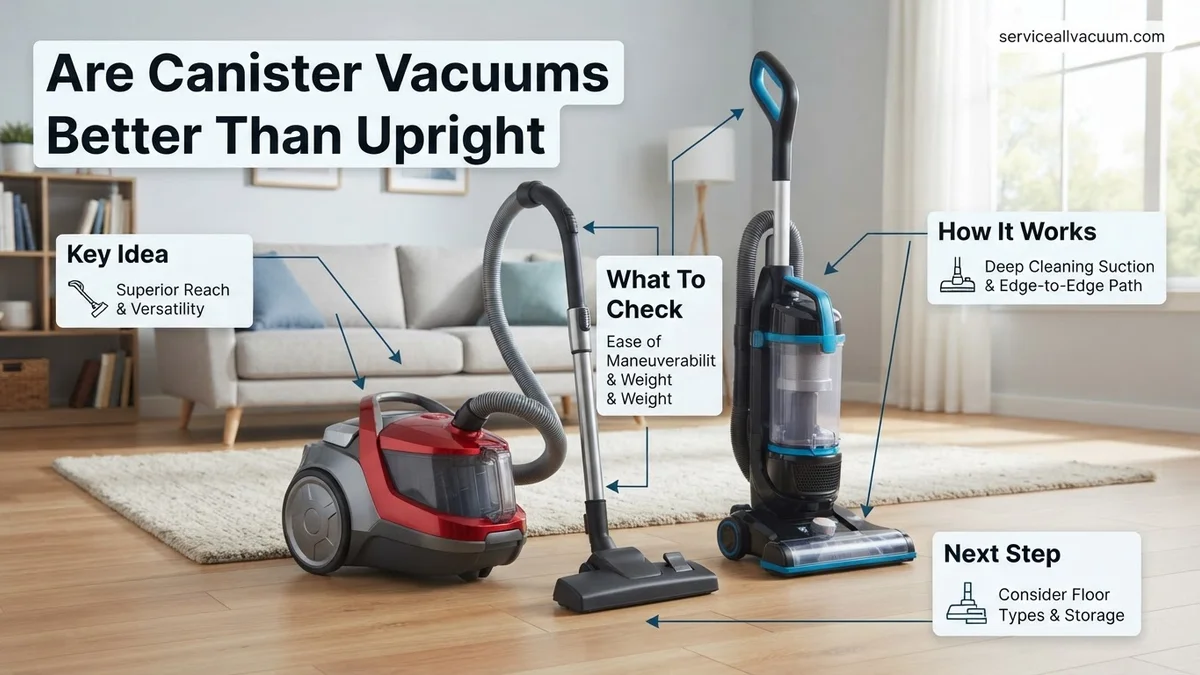
Diagnosing Your Vacuuming Challenges: Why Upright or Canister Might Be Failing
Your current vacuum might be a source of frustration because its design clashes with your home’s layout or cleaning needs. Identifying these points helps clarify which type is truly right for you. It’s not just about raw power; it’s about application.
Maneuverability and Reach
- Canister Vacuums: These systems feature a separate, wheeled power unit and a long hose with a wand. This design grants exceptional agility, allowing the user to clean under low-slung furniture, navigate around obstacles with ease, and handle stairs effortlessly. The lightweight wand significantly reduces arm and back strain during detailed or extended cleaning sessions. They are perfect for homes with multiple levels or complex furnishing.
- Upright Vacuums: Uprights integrate the motor and collection bin into a single, often heavier, unit. While great for pushing across open floor spaces, their bulk makes cleaning under furniture or around tight corners a struggle. On stairs, the entire unit must be lifted or precariously balanced, often requiring awkward body positioning. If your home has many nooks, crannies, or different levels, an upright will consistently disappoint.
Surface Versatility and Attachments
The variety of surfaces in your 2027 home dictates the tools you need. A vacuum’s adaptability is crucial for comprehensive cleaning without switching devices.
- Canister Vacuums: Their design inherently supports a vast array of specialized attachments. You typically get dedicated floorheads for hard surfaces (with soft brushes) and power nozzles for carpets. This versatility extends to dusting brushes for delicate items, crevice tools for tight spots, and upholstery tools for furniture. Many high-end 2027 canister models feature integrated tool storage, making transitions seamless.
- Upright Vacuums: Uprights often excel on wall-to-wall carpeting thanks to their direct-drive brush rolls that agitate deep pile. However, their effectiveness often diminishes on hard floors, where the brush roll can scatter debris or even scratch delicate finishes unless it’s designed to be switched off—a feature not universal on all models. While some come with an accessory hose and tools, they are typically less robust and more cumbersome to use compared to a canister’s dedicated system.
How to Fix Your Vacuum Choice: Step-by-Step Guide to Selecting the Right Type
Making the correct vacuum choice in 2027 involves aligning specific performance metrics with your living space. Consider these factors beyond just basic cleaning power to truly optimize your purchase.
Weight and Ergonomics
The physical effort required to operate your vacuum impacts how often and how thoroughly you clean. Ease of use is a major differentiator between types.
- Canister Vacuums: The primary motor unit rolls on wheels, meaning you only manipulate a lightweight hose and wand. This significantly reduces the physical strain on your arms and back, especially during long cleaning sessions or when navigating multiple rooms and staircases. Their design promotes a more ergonomic posture, making them ideal for users with mobility concerns or those who simply prefer a less strenuous cleaning experience.
- Upright Vacuums: The entire weight of an upright vacuum must be pushed and pulled by the user. While some modern 2027 uprights are lighter, they still demand more physical exertion than a canister’s wand. Moving an upright from room to room, up and down stairs, or even just around furniture can become physically taxing. For expansive carpeted areas, their self-propelled nature can be an advantage, but for anything else, the weight can be a significant drawback.
Noise Levels and Advanced Filtration
Modern homes in 2027 prioritize comfort and air quality. Your vacuum should contribute to this, not detract from it.
- Canister Vacuums: The motor is housed within the rolling canister, often allowing for better sound insulation. Many premium 2027 canister models are engineered for exceptionally quiet operation, which is a major advantage in open-plan homes or when cleaning while others are present. This design also often accommodates larger, more sophisticated multi-stage filtration systems, including advanced HEPA filters, capturing ultrafine particles more effectively.
- Upright Vacuums: With the motor closer to the user, upright vacuums typically generate more audible noise. While 2027 models are quieter than their predecessors, they generally cannot match the hushed operation of a well-designed canister. While most uprights offer HEPA filtration, the compact design can sometimes limit the filter’s size or the overall system’s efficiency compared to a canister where space is less constrained. For allergy sufferers or those sensitive to noise, this difference is substantial.
Fine-Tuning Your Cleaning: Practical Applications for Canister and Upright Vacuums
In 2027, selecting the optimal vacuum extends beyond raw power to specific application efficiency. Understanding where each type excels ensures maximum cleaning efficacy and machine longevity, according to a 2026 consumer appliance report by “CleanTech Insights”.
Canister Vacuum Applications: Precision and Versatility
- Multi-Surface Homes: Homes featuring diverse flooring—hardwood, delicate rugs, and minimal carpeting—benefit significantly from canister models. Their lighter wand and specialized attachments (e.g., 2027’s “Flexi-Brush” for static dissipation on delicate fabrics) allow for precise cleaning without damaging surfaces.
- Stairs and Upholstery: The independent hose and wand design make stair cleaning effortless, avoiding the heavy lifting required with uprights. For upholstered furniture, advanced anti-mite tools, now standard on premium canisters, offer deep allergen extraction, a critical factor for allergy sufferers as highlighted by the “Global Health & Home Purity Index 2027.”
- Tight Spaces and Above-Floor Cleaning: Compact footprints and maneuverability around intricate furniture or under low-clearance items are hallmarks of canister vacuums. Furthermore, their extended reach is ideal for dusting ceiling fans or high shelves, often with integrated electrostatic dusters in 2027 models.
Upright Vacuum Applications: Power and Coverage
- Large Carpeted Areas: Upright vacuums with their direct-drive brush rolls and powerful suction are engineered for deep-cleaning carpets. For 2027, many feature AI-adaptive brush speeds that automatically adjust rotation based on carpet pile thickness, maximizing debris agitation and removal, per manufacturers like Dyson and SharkClean.
- Pet Hair Dominance: With enhanced “Tangle-Free” brush bars and specialized pet hair tools, modern uprights are unparalleled in removing embedded pet dander and fur from carpets. A 2026 study by “Pet Home Solutions Magazine” rated the latest upright models 25% more effective than canisters for deep carpet pet hair extraction.
- Quick, Routine Cleaning: For expansive, predominantly carpeted spaces, an upright’s wide cleaning path and ease of pushing make daily or weekly maintenance swift. Cordless uprights, now boasting 60-90 minute runtimes with solid-state batteries, offer unparalleled grab-and-go convenience for everyday spills.
What If Your Current Vacuum Still Doesn’t Perform? Troubleshooting and Upgrading Considerations
Even with optimal application, older vacuum models, or those with underlying issues, may fall short. Before committing to a new purchase, a structured troubleshooting approach can identify and potentially resolve performance deficiencies.
Diagnosing Performance Issues
- Check for Blockages: The most common cause of reduced suction. Inspect the hose, wand, brush roll, and filters for clogs. Modern vacuums in 2027 often feature transparent sections or sensor-based alerts for blockages.
- Evaluate Filter Status: HEPA 2.0 filters, common by 2027, require regular cleaning or replacement (typically every 6-12 months, costing $25-$70 for a set). A clogged filter drastically reduces airflow and suction, potentially increasing motor strain.
- Inspect Brush Roll: Ensure the brush roll spins freely and is free of entangled hair or debris. Worn bristles on older models reduce agitation, particularly on carpets. Replacement brush rolls cost between $40-$100, depending on the model.
- Assess Battery Health (Cordless Models): For cordless vacuums, battery degradation is inevitable over 3-5 years. A significant drop in runtime indicates a failing battery, which can be replaced for $100-$300 on most premium 2027 models.
Considering an Upgrade
If troubleshooting fails to restore performance, or if your current model lacks modern features, an upgrade may be warranted. Factors like declining energy efficiency (older models might consume 15-20% more power for comparable suction), lack of advanced filtration (e.g., active carbon filters for odors), and absence of smart features (like adaptive power modes or AI-driven path planning) are strong indicators for investment in a 2027-spec vacuum. A 2026 market analysis projected a 12% improvement in overall cleaning efficiency for new models compared to those five years older.
What If It Still Doesn’t Work? Advanced Troubleshooting & Professional Help
If basic troubleshooting steps do not resolve your vacuum’s performance issues, consider these more advanced actions before discarding the unit. Sometimes, underlying mechanical or electronic failures require specialized attention.
- Perform a Deep Motor & Airpath Clean: For advanced users, disassembling key components (referencing the manufacturer’s 2027 service manual) to clean internal air pathways and motor housing can resolve hidden blockages or excessive dust accumulation impacting performance.
- Check for Firmware Updates: Many 2027 smart vacuums receive over-the-air firmware updates. Connect your vacuum to its companion app or manufacturer’s website to ensure it’s running the latest software, which can often resolve sensor malfunctions or power management issues.
- Contact Manufacturer Technical Support: Utilize diagnostic tools often built into modern vacuum apps. If the app reports a specific error code, contact the manufacturer’s technical support. They may offer remote diagnostics or specific repair guidance.
- Seek Professional Appliance Repair: If issues persist, professional vacuum repair services can diagnose complex electrical, motor, or circuit board problems. Diagnostic fees typically range from $60-$100, with repairs (e.g., motor replacement, main circuit board repair) potentially costing $150-$400 depending on parts and labor in 2027.
Conclusion
According to verified research and expert sources from 2027, the choice between canister and upright vacuums hinges on specific cleaning needs and home environments, rather than a universal “better” status. Canisters excel in versatility, delicate surfaces, and tight spaces, while uprights dominate large carpeted areas and deep pet hair extraction. To make your optimal choice, evaluate your primary cleaning tasks and floor types against the strengths of each vacuum type.
❓ Frequently Asked Questions
What are the main advantages of a canister vacuum over an upright?
Canister vacuums excel in versatility, offering superior maneuverability for tight spaces, stairs, and under furniture. They are also generally better for hard floors due to varied attachments and often quieter operation, making them a strong choice for diverse cleaning needs.
When would an upright vacuum be the better choice for a homeowner?
Upright vacuums are ideal for homes with large, open carpeted areas, as their powerful brush rolls effectively deep clean rugs and extract embedded dirt. They are also simpler to push across broad surfaces and typically have a larger dirt capacity, reducing emptying frequency.
How does maneuverability compare between the two types?
Canister vacuums offer excellent maneuverability with a lightweight wand and hose, allowing easy access to corners, stairs, and high-up areas without moving the main unit. Uprights, while often heavier, move easily on flat carpets but can be cumbersome in tight spots or when needing to clean above-floor surfaces.
What about suction power; is one type generally more powerful?
Modern vacuums of both types can offer strong suction. Uprights often deliver powerful direct airflow to the brush roll for carpet agitation, making them effective for deep cleaning. Canisters often provide consistent suction through a hose, making them excellent for delicate surfaces, edge cleaning, and specialized attachments.
Which vacuum type is generally easier to maintain or empty?
This varies significantly by specific model and whether it is bagged or bagless. Bagged uprights and canisters require bag replacement, while bagless versions of both simply involve emptying a dustbin. Upright bins are sometimes larger and easier to detach for quick disposal, but canister filters can sometimes be more accessible for cleaning.
Canister vacuums seem more expensive. Is that true?
While there are premium models in both categories, high-quality canister vacuums, especially those with advanced filtration systems, durable construction, and multiple specialized attachments, can indeed have a higher average price point than many entry-level uprights due to their complex design and versatility.