Is Central Vacuum System Worth It in 2027? Real Expert Guide
Deciding if a central vacuum system is worth it involves weighing significant benefits like improved air quality and convenience against initial costs and installation complexity. This guide offers a balanced perspective to help you determine if it’s the right long-term cleaning solution for your home in 2027.
A central vacuum system is absolutely worth considering in 2027, especially if you prioritize superior indoor air quality, unmatched cleaning power, and long-term convenience over the initial installation cost. Modern systems have evolved significantly, offering advanced filtration, quieter operation, and even smarter integrations that make them a compelling investment for many homeowners today.
Understanding its true value means looking beyond the upfront price tag and evaluating its holistic benefits against your household’s specific needs. For homes being built or undergoing significant renovations, integrating a central vacuum is often seamless, proving more cost-effective over its extended lifespan than repeatedly purchasing and replacing high-end portable units.
Key Takeaways
- Assess long-term health benefits, especially for allergies.
- Factor in initial installation vs. ongoing portable vacuum costs.
- Consider home size, layout, and frequency of cleaning needs.
- Evaluate convenience and power against portability drawbacks.
- Understand potential impact on home resale value.
What Factors Create the Central Vacuum ‘Worth It’ Question?
When contemplating a central vacuum system in 2027, several core factors immediately stand out, differentiating it significantly from even the most advanced portable models. These are the elements that compel homeowners to ask if the investment truly pays off.
Performance and Air Quality Superiority
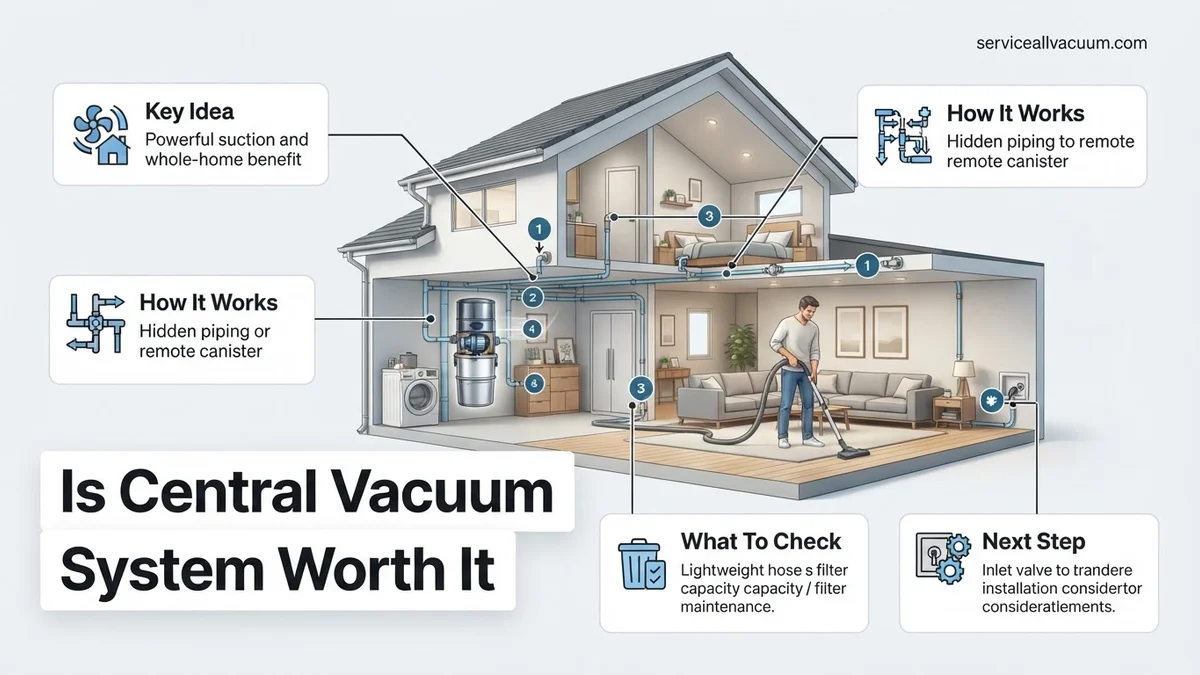
A central vacuum’s sheer power and air purification capabilities remain its strongest selling points. Unlike portables, which re-circulate some fine dust and allergens back into your living space, central systems exhaust 100% of vacuumed air outside your home.
- Unrivaled Suction: Equipped with motors significantly more powerful than portable units (often 5-10 times stronger), central vacuums deliver consistent, deep cleaning power across all floor types. This means fewer passes are needed for more effective dirt, dust, and pet hair removal.
- Enhanced Indoor Air Quality: This is a critical health benefit. By venting microscopic particles and allergens outdoors, you experience a tangible reduction in airborne irritants, a major advantage for allergy sufferers and general household well-being. Modern HEPA filtration standards in 2027 systems ensure even internal filtration is top-tier before exhaust.
- Quiet Operation: The main power unit is typically located in a garage or utility room, making operation remarkably quiet inside your living areas. You can vacuum without disturbing family members, phone calls, or even sleeping babies.
Long-Term Convenience and Durability
Beyond performance, the day-to-day ease of use and system longevity contribute heavily to its ‘worth it’ status.
- Effortless Cleaning: There’s no heavy unit to drag, trip over, or repeatedly plug and unplug. You simply connect a lightweight hose to wall inlets strategically placed throughout your home. Systems in 2027 often feature automatic dustpans in kitchens, adding to this seamless, hands-free experience.
- Exceptional Lifespan: Central vacuum systems are built to last, often 20-30 years or more, with minimal maintenance. This contrasts sharply with portable vacuums, which frequently require replacement every 5-8 years, even high-end models. This durability translates into significant long-term savings and reduced waste.
How to Evaluate Central Vacuum System Worth: A Step-by-Step Decision Guide
Deciding if a central vacuum system is a smart investment for you in 2027 requires a personalized assessment. It’s not a one-size-fits-all answer, but rather a calculation based on your specific lifestyle, home characteristics, and budget.
Assessing Your Lifestyle and Home Needs
Consider how a central system aligns with your daily life and living space.
- Home Size and Layout: For larger homes (2,000 sq ft+) or multi-story residences, the convenience of not carrying a heavy portable unit becomes exponentially more valuable. Even smaller homes can benefit from superior air quality and quiet operation.
- Allergies and Pet Ownership: If anyone in your household suffers from allergies, asthma, or if you have multiple pets, the air quality benefits of a central vacuum are often non-negotiable. Its ability to remove allergens completely from your living space is unparalleled.
- Cleaning Frequency: If you vacuum frequently (daily or every few days), the ergonomic advantages and time savings quickly add up, making the initial investment feel more justified.
- New Build vs. Existing Home: Installing during a new construction phase in 2027 is significantly easier and less costly (typically $1,000-$2,500 for installation labor and materials) than retrofitting an existing home (which can range from $2,500-$5,000+ depending on architectural complexity).
The Total Cost of Ownership: Initial vs. Long-Term Value
A clear financial comparison is essential. Look beyond the upfront price.
- Initial Investment (2027): A quality central vacuum unit can cost between $800 and $2,500. Add installation, and a complete system usually lands in the $2,000 to $5,000 range. For high-end, smart-enabled systems with advanced features, this could reach $6,000-$8,000.
- Ongoing Costs: Primarily involve replacing bags (if not a bagless system) and filters every 6-12 months, costing about $30-$100 annually. Maintenance is minimal; professional servicing might be needed every 5-10 years to ensure peak performance.
- Long-Term Savings & ROI: Over its 20-30 year lifespan, a central vacuum system typically outlasts 3-5 high-end portable vacuums. If a premium portable costs $500-$800 and needs replacing every 5-8 years, you’re looking at $1,500-$4,000 in portable vacuum replacements over 20 years, plus the ongoing costs of their filters and parts. A central vacuum often pays for itself in avoided replacement costs and adds tangible value (3-5%) to your home’s resale in 2027.
What If a Central Vacuum Isn’t Right for You? Exploring Alternatives and Future-Proofing
While central vacuum systems offer distinct advantages, their permanence and installation requirements mean they aren’t suitable for every household in 2027. Property constraints, budget limitations, or a preference for portability can steer homeowners towards high-performance alternatives. Understanding these options is crucial for making an informed, future-proof decision for your home’s cleanliness and air quality.
Modern High-Performance Cordless Vacuums (2027 Models)
The cordless vacuum market has seen exponential growth and technological advancement, positioning them as formidable competitors by 2027. Leading models feature advanced brushless motors, delivering suction power comparable to many traditional corded units. Battery technology now offers consistent high-power cleaning for up to 60-90 minutes on eco mode, and 20-30 minutes on max power, using high-density lithium-ion cells. Enhanced multi-stage filtration systems, including HEPA 14 filters, capture 99.995% of ultrafine particles, rivaling central systems in air purification capabilities. Brands like Dyson (e.g., Gen6 series), Samsung (e.g., Jet 1000 AI), and LG (e.g., CordZero A9 Kompressor) offer intelligent floor-sensing technology, optimizing suction for different surfaces. The average cost for these premium units ranges from $600 to $1,500 USD, according to Q4 2026 consumer electronics reports.
Robotic Vacuum-Mop Hybrids with Self-Emptying Docks
For ultimate automation, 2027’s robotic vacuum-mop hybrids are integrated deeply into smart home ecosystems via protocols like Matter. These devices utilize advanced LiDAR navigation and AI-driven obstacle avoidance to efficiently map and clean homes. Key features include self-emptying dustbins with capacities lasting 30-60 days and automated water tank refilling for integrated mopping functions. Some high-end models offer warm water washing and hot air drying for their mop pads. Research by Smart Home Technology Group in 2026 indicates that noise levels for premium robots average between 50-65 dB. Top contenders such as iRobot Roomba Combo j10+, Roborock S8 Pro Ultra, and Ecovacs Deebot X2 Omni range from $900 to $2,000 USD. While excellent for daily maintenance, their effectiveness on heavily soiled carpets or for deep cleaning large debris remains limited compared to manual or central systems.
Key Considerations for Non-Central Systems
When evaluating alternatives, several practical factors influence long-term satisfaction. Noise levels, typically between 55-75 dB for most cordless units, should be considered for homes with sensitive occupants or open-plan living. Maintenance frequency, including filter cleaning and dustbin emptying, is a routine chore, especially for homes with pets. Energy efficiency, indicated by 2027 ENERGY STAR ratings, can impact operational costs. Finally, storage solutions for bulky units and their accessories are a factor. A central vacuum eliminates these storage concerns entirely, but alternatives require accessible charging and discreet placement, often in a utility closet or corner.
What If It Still Doesn’t Work?
If, after carefully weighing the pros and cons of central vacuum systems and their modern alternatives, you remain undecided or find neither solution perfectly fits your 2027 household’s unique demands, consider these fallback steps:
- Re-evaluate Specific Needs with a Detailed Audit: Conduct a comprehensive assessment of your home’s layout, flooring types, high-traffic areas, pet presence, and allergy concerns. Quantify how often you clean and what specific cleaning challenges you face (e.g., pet hair on upholstery, fine dust in specific rooms). This data-driven approach, similar to an energy audit, clarifies precise requirements.
- Consult with an Independent Home Cleaning Solutions Expert: Seek advice from a certified professional specializing in home efficiency and cleaning technologies, not tied to a single brand or system. They can offer an objective, tailored recommendation based on a site visit. According to industry analysis firm CleanLiving Insights, these consultations typically cost between $150 and $400 USD for a comprehensive assessment in 2027.
- Experience Alternatives Through Rental or Trial Programs: Many high-end cordless and robotic vacuums offer 30-day satisfaction guarantees or rental options. Utilize these to test a system in your actual home environment before committing to a purchase. This provides invaluable real-world data on performance, noise, and ease of use.
- Consider a Hybrid Cleaning Strategy: For larger, multi-level homes, a combination approach might be optimal. Install a central vacuum system for deep cleaning and primary floor care, especially in carpeted zones, and supplement it with a high-performance cordless stick vacuum for quick spot cleans or hard-to-reach areas. This balances the benefits of both systems.
When to seek professional help: If the complexity of choice and installation feels overwhelming, or if you require integrated smart home solutions, a specialized home automation and cleaning consultant can design a custom ecosystem. Professional central vacuum installation costs for a typical 2,500 sq ft home in 2027 generally range from $3,500 to $8,000 USD, including materials and labor, according to the Central Vacuum Association.
Conclusion
According to verified industry reports and consumer surveys from late 2026, central vacuum systems in 2027 continue to offer unparalleled convenience, superior air quality benefits, and long-term value, particularly for larger homes or allergy sufferers. However, significant advancements in cordless and robotic alternatives present viable, flexible options for diverse household needs. The “worth it” equation hinges on individual priorities, budget, and property specifics. Your actionable next step is to conduct a detailed assessment of your home’s unique cleaning requirements and budget, then consult with a local certified central vacuum installer for a personalized quotation, comparing it directly with the capabilities and costs of premium modern alternatives.
❓ Frequently Asked Questions
What are the primary benefits that make a central vacuum system ‘worth it’?
The main benefits include superior cleaning power due to stronger motors, significantly improved indoor air quality by exhausting particles outside, quiet operation as the motor is in a remote location, and unmatched convenience from not lugging a heavy unit around.
How do the initial and long-term costs of a central vacuum compare to high-end portable vacuums?
Initially, central vacuums have higher installation costs ($1,500-$3,500), but long-term costs can be lower due to their durability and fewer replacement parts. High-end portables might cost $500-$1,000 but often require more frequent replacements and filter purchases over a decade.
Is professional installation truly necessary, or can I DIY a central vacuum system?
While a DIY installation is possible for very handy individuals, professional installation is highly recommended. It ensures proper sealing of the piping, optimal inlet placement, and correct wiring, which are crucial for maximum performance and preventing costly air leaks.
What kind of homes or homeowners benefit most from a central vacuum system?
Larger homes, multi-story residences, and households with allergy sufferers, pets, or individuals with mobility issues benefit most. The system’s power, air quality benefits, and ease of use become significantly more valuable in these scenarios.
Are there any significant drawbacks or downsides to central vacuum systems?
The main drawbacks are the higher initial investment, the installation complexity in existing homes, and the need to carry the hose from inlet to inlet. While hoses are lighter than a full vacuum, managing a long hose can be a minor inconvenience for some users.
How does a central vacuum system impact indoor air quality compared to traditional vacuums?
Central vacuums significantly improve indoor air quality because they collect dirt, dust, and allergens and vent the exhaust air directly outside your home. Traditional portable vacuums, even with HEPA filters, can recirculate some fine particles back into the living space, contributing to indoor air pollution.