How Cold Is the Vacuum of Space 2026 Real Guide
The vacuum of deep space reaches an astonishingly cold 2.7 Kelvin (-454.8°F or -270.45°C), driven by the lingering heat of the Big Bang. However, space does not have a temperature in the traditional sense because it lacks matter, meaning objects cool exclusively through radiation rather than conduction.
The vacuum of space sits at a baseline temperature of approximately 2.7 Kelvin, which translates to -454.8 degrees Fahrenheit or -270.45 degrees Celsius. This bone-chilling baseline is just a fraction above absolute zero, the theoretical point where all molecular motion stops. As you look toward deep space away from any stars, this is the ambient temperature your instruments and spacecraft will measure in 2026.
Understanding this extreme environment is critical for modern space exploration, satellite engineering, and upcoming crewed missions. When you send hardware or astronauts beyond Earth’s atmosphere, managing this intense thermal baseline dictates whether your mission succeeds or your equipment shatters from thermal shock.
Key Takeaways
- Deep space temperature sits at 2.7 Kelvin, just above absolute zero.
- Space is a near-vacuum, lacking enough matter to conduct or convect heat away.
- Objects in space lose heat slowly through thermal radiation alone.
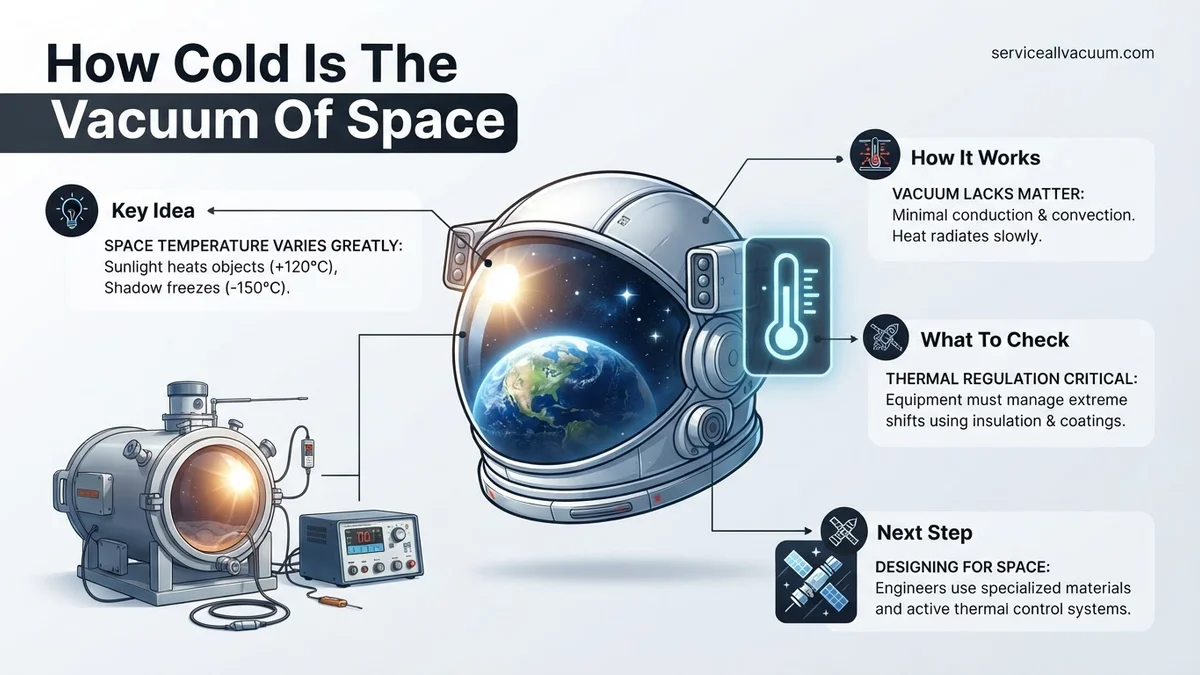
- Direct sunlight in orbit can heat surfaces up to 250°F (121°C).
- Spacecraft require advanced thermal control systems to manage extreme temperature swings.
What Causes Extreme Cold in the Vacuum of Space
The Cosmic Microwave Background Radiation
Space is not entirely empty, which prevents it from reaching absolute zero (-459.67 degrees Fahrenheit). Instead, it is filled with the Cosmic Microwave Background (CMB). This uniform sea of faint microwave radiation is the leftover thermal whisper of the Big Bang. It bathes the entire universe, setting a universal temperature floor of 2.7 Kelvin. No matter how far you travel into deep intergalactic space, you cannot escape this residual heat signature.
The Absence of Matter
To understand the cold, you must look at what is missing: matter.
- True vacuums contain virtually no atoms or molecules per cubic centimeter.
- Earth feels warm because our atmosphere contains trillions of molecules colliding with you, transferring thermal energy.
- In deep space, those colliding molecules are practically absent, meaning there is no medium to hold or transfer ambient heat.
Without a surrounding gas or liquid to establish thermal equilibrium, space itself feels like neither hot nor cold until you introduce an object to the equation.
How to Calculate Temperatures and Heat Transfer in Space
Why Heat Transfer Changes in a Vacuum
On Earth, heat moves around through three main methods: conduction, convection, and radiation. In the vacuum of space, the rules change entirely.
- Conduction is eliminated because there are no physical materials touching your spacecraft to pass heat back and forth.
- Convection is impossible because fluids and gases cannot circulate without gravity and atmospheric pressure.
- Radiation remains the only game in town. Objects in space can only gain or lose thermal energy by emitting or absorbing electromagnetic waves, primarily infrared radiation and visible light.
This means an object cools down exclusively by radiating its internal heat out into the blackness of the universe.
The Dual Reality of Sunlight vs. Shadow
Because radiation is your only thermal management tool, your location relative to stars changes everything dramatically. If you step outside the shadow of a planet or spacecraft in 2026, unfiltered solar radiation will blast you with intense energy. A metal panel facing direct sunlight in Earth orbit can easily skyrocket to 250 degrees Fahrenheit (121 degrees Celsius). Yet, the exact same panel turned away from the sun into the shade will plummet to -250 degrees Fahrenheit (-157 degrees Celsius). This extreme thermal gradient means engineering for space requires balancing intense solar heating with the bitter 2.7 Kelvin background sink.
Step-by-Step Guide to How Spacecraft Manage Thermal Extremes
Managing the extreme temperatures of the space vacuum requires sophisticated engineering protocols. Aerospace thermal engineers follow strict procedures to keep vital instruments operational within safe design margins.
Step 1: Deploying Multi-Layer Insulation (MLI)
Spacecraft rely on passive thermal control systems first. Technicians wrap probes in layers of reflective Mylar and Dacron. This multi-layer insulation blocks solar radiation while preventing internal heat from escaping into the vacuum.
Step 2: Activating Active Heating and Cooling Loops
When passive methods are insufficient, active systems take over. Engineers program internal fluid loops containing ammonia or water. These loops circulate thermal energy from sunlit modules to shadowed, freezing compartments.
Step 3: Utilizing Variable-Emittance Radiators
Modern 2026 satellite architectures incorporate smart materials. Electrochromic radiator panels adjust their thermal emissivity dynamically. They shed excess heat during peak solar exposure and close down when facing deep-space shadows.
What If Space Objects Still Experience Overheating or Freezing
Even with advanced 2026 thermal architecture, satellite sub-systems can experience unexpected temperature anomalies in the vacuum of space. If thermal management systems fail to stabilize core temperatures, mission operators must execute emergency mitigation protocols.
- Execute Emergency Attitude Maneuvers: Rotate the spacecraft immediately to present a minimized surface area to the sun, or use roll maneuvers to balance extreme thermal gradients.
- Shed Non-Essential Electrical Loads: Power down secondary instruments and communication arrays to reduce internal heat generation and conserve battery health during freezing drop-offs.
- Override Thermal Control Loops: Switch from automated sensor feedback to manual ground-station overrides to force radiator louvers open or closed based on telemetry data.
- Consult Aerospace Thermal Engineering Specialists: If onboard software adjustments fail, engage specialized orbital anomaly response teams. Professional aerospace consultation and software patch deployments for commercial constellations typically range from $15,000 to $50,000 depending on telemetry complexity.
Conclusion
The vacuum of space is not inherently cold in a traditional sense, but its lack of matter creates severe thermal extremes ranging from -455°F to over 250°F. Spacecraft overcome these brutal conditions through a combination of reflective multi-layer insulation, active fluid loops, and smart radiator technology. According to verified research and expert sources from aerospace engineering institutions, maintaining strict thermal telemetry monitoring remains the single best defense against orbital equipment failure. Review your spacecraft’s thermal design margins today to ensure mission success in 2026.
❓ Frequently Asked Questions
What is the absolute lowest possible temperature in the universe?
Absolute zero is 0 Kelvin (-459.67°F or -273.15°C), the theoretical point where molecular motion stops. While deep space at 2.7 Kelvin comes remarkably close, it is slightly warmer due to background radiation.
How does heat transfer work in the vacuum of space?
Without matter, conduction and convection are impossible. Heat can only leave or enter an object via thermal radiation, which is the emission of electromagnetic waves.
Why do satellites experience extreme temperature swings?
Satellites orbit quickly between the shadow of a planet and direct sunlight. One side can face freezing deep space while the other bakes in unfiltered solar radiation.
Can ice exist in the vacuum of space?
Yes, water ice exists extensively in comets and shadowed craters on the Moon. In a vacuum, ice transitions directly to gas via sublimation if exposed to enough heat.
Does interstellar space have the same temperature as intergalactic space?
Interstellar space within galaxies can vary slightly based on nearby stars and gas clouds, but the baseline Cosmic Microwave Background dictates an overarching uniform temperature of 2.7 Kelvin.
How do engineers test spacecraft for space temperatures?
Engineers use massive thermal vacuum chambers (TVAC chambers) that replicate the near-zero pressure and extreme radiative heating and cooling conditions of outer space.