How Long to Vacuum Car AC System Expert 2026 Guide
Most car AC systems require 30 to 45 minutes of vacuum pump time to effectively remove air, moisture, and non-condensables. Larger systems or those exposed to high humidity may need up to a full hour to reach the necessary pressure threshold.
When you are servicing your vehicle air conditioning, you need to run your vacuum pump for a minimum of 30 to 45 minutes before adding any refrigerant. If you are dealing with a completely open system, a larger truck or SUV, or working on a humid 2026 summer day, you should extend that runtime to a full hour to guarantee proper moisture boiling and removal.
Skipping this step or cutting the vacuum time short leaves moisture and non-condensable gases trapped inside your aluminum lines and evaporator core. Even a microscopic amount of trapped water will mix with your refrigerant and PAG oil to create corrosive acids, destroying your compressor from the inside out. Putting in the time upfront guarantees cold, reliable air conditioning performance.
Key Takeaways
- Run your vacuum pump for a minimum of 30 to 45 minutes.
- Target a deep vacuum of under 500 microns or 29.9 inHg.
- High humidity and large systems require up to 60 minutes.
- Always perform a 10-minute isolation decay test to check for leaks.
- Boiling off moisture relies on sustained low pressure, not just time.
Why Vacuuming a Car AC System is Necessary
You cannot simply charge a refrigerant loop that contains air or humidity. A dedicated automotive vacuum pump forces the internal system pressure down far below normal atmospheric levels, changing the physical properties of any trapped moisture inside your vehicle components.
The Boiling Point Effect
- Under standard atmospheric conditions, water boils at 212 degrees Fahrenheit (100 degrees Celsius).
- Dropping your AC system pressure down into a deep vacuum drastically lowers that boiling point.
- Water trapped inside the narrow coils of your evaporator turns into vapor at ambient garage temperatures.
- Once the water turns to a gas, your vacuum pump can easily suck it out through the manifold gauges.
Removing Contaminants
Air contains oxygen and moisture, neither of which belong in a sealed R-134a or R-1234yf circuit. Non-condensable gases take up valuable space in your condenser, causing high head pressures and poor cooling efficiency. Pulling a proper vacuum strips the system clean so only pure refrigerant and specialized lubricant remain when you complete your recharge.
How Long to Run the Vacuum Pump for Optimal Results
Every professional technician knows that AC evacuation is not a race. While a standard passenger car sedan with a completely dry system might only require 30 minutes of pump time, rushing the process invites costly system failures down the road.
Standard Timing Breakdown
- 30 Minutes: The absolute baseline for a small passenger car with a warm, recently sealed system.
- 45 Minutes: The recommended sweet spot for most standard vehicles to ensure total atmospheric evacuation.
- 60 Minutes: Required for larger trucks, dual-zone minivans, or systems that sat open to the air for days.
Target Pressure and Micron Readings
Do not rely solely on your watch to judge when the vacuuming is done. You need to monitor your equipment to confirm the job is complete. Your low-side compound gauge should pull down to a solid 29.9 inHg (inches of mercury). If you are using a digital micron gauge—the gold standard for modern 2026 auto repair—you want to see the reading drop and hold firmly below 500 microns before closing your manifold valves.
Step-by-Step Guide to Pulling a Deep Vacuum and Testing for Leaks
Executing a proper evacuation requires strict adherence to automotive HVAC protocols. Following a precise procedure ensures maximum moisture removal and reliable leak detection before you introduce fresh refrigerant into the system.
1. Hook Up the Manifold Gauges
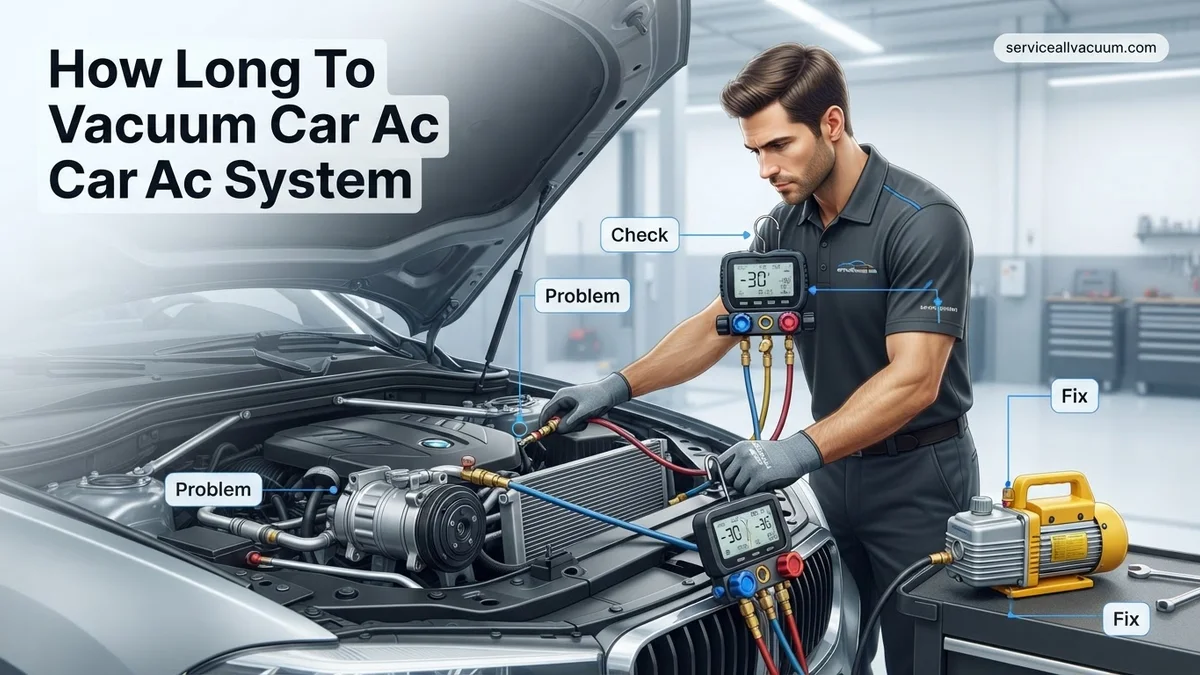
Connect your blue low-side hose to the low-pressure service port and the red high-side hose to the high-pressure service port. Ensure both manifold valves remain closed while you attach the center yellow hose directly to the inlet port of your vacuum pump.
2. Start the Pump and Open the Valves
Power on your dual-stage vacuum pump, then open both the high and low manifold valves. You should immediately see the low-side gauge drop rapidly into a deep vacuum state, moving past 25 inches of mercury toward 29.9 inches.
3. Monitor the Micron Level and Hold
Allow the pump to run for the required duration, aiming for a reading below 500 microns on a digital micron gauge. Once achieved, close both manifold valves, turn off the pump, and observe the gauges for 10 to 15 minutes to verify the system holds pressure without rising.
What If It Still Doesn’t Work?
If your car’s AC system fails to hold a vacuum during the leak test, do not proceed with recharging. According to ASE-certified mobile HVAC guidelines for 2026, bypassing a failed vacuum test guarantees refrigerant loss and environmental contamination. Try these fallback steps if your pressure rises:
- Perform a nitrogen pressure test: Introduce dry nitrogen up to 150 PSI into the system and use an electronic leak detector or soapy water solution to bubble-test all service ports, line fittings, and component joints.
- Inspect Schrader valves: Core service valves frequently leak over time; replacing faulty valve cores often resolves minor vacuum loss immediately for under $10 in parts.
- Check compressor shaft seals: If you notice oily residue around the front clutch assembly, the compressor shaft seal is likely compromised and requires component replacement.
- Know when to seek professional help: If stubborn leaks persist within the evaporator core buried deep inside the dashboard, professional recovery and dashboard disassembly are required. Professional leak diagnosis and repair generally range from $150 to $400 excluding parts.
Conclusion
Properly evacuating a vehicle air conditioning system demands patience, exact timing, and precision equipment to achieve the target 500-micron threshold. Skipping this vital step leads to trapped moisture, acid formation, and compressor failure. According to verified research and automotive HVAC industry standards, taking the time to pull a thorough 45-minute to 60-minute vacuum ensures optimal cooling performance and system longevity. Your next actionable step is to connect a calibrated micron gauge to your manifold set and begin your evacuation cycle today.
❓ Frequently Asked Questions
How long to vacuum car AC system if it was left open to the atmosphere?
If components like lines or the compressor were left open to ambient air, you should vacuum the system for a full 45 to 60 minutes. Extended time is required to evaporate any trapped humidity or water droplets.
What gauge reading indicates the vacuum process is finished?
Your low-side gauge should read maximum vacuum, typically around 29.9 inHg (inches of mercury). For precision, a digital micron gauge should read steady below 500 microns.
Can I use a venturi vacuum pump driven by compressed air?
While venturi pumps can pull a basic vacuum, electric two-stage vacuum pumps are strongly recommended. Electric pumps achieve the deep micron levels needed to boil off moisture effectively.
What causes the vacuum reading to rise during the decay test?
If the vacuum reading creeps back up toward zero, it usually indicates either an active refrigerant leak or residual moisture still boiling off inside the system components.
Does ambient temperature affect how long the vacuum takes?
Yes, lower ambient temperatures make moisture harder to evaporate. Warming up the vehicle or garage can help speed up the moisture removal process during evacuation.
Should I change my vacuum pump oil before starting?
Always check your pump oil before use. Fresh, clean oil is critical for the pump to reach the deep 500-micron vacuum required for a proper AC recharge.