Is There Gravity in a Vacuum Real Facts for 2026 Guide
Yes, gravity absolutely exists in a vacuum. Gravity is a fundamental property of mass and spacetime, meaning it travels through empty space and does not require air or matter to function.
Yes, gravity absolutely exists in a vacuum. In fact, some of the strongest gravitational pulls in the universe operate in the nearly complete vacuum of outer space. A common misconception suggests that because a vacuum lacks air and matter, it must also lack gravity. However, gravity does not need air, pressure, or a medium to travel through.
As you look toward science and space exploration in 2026, understanding this distinction is crucial. It explains everything from how planetary orbits function to why modern satellite technology stays in place. Separating the concept of a vacuum from the force of gravity helps you understand how the universe actually works.
Key Takeaways
- Gravity does not require air, pressure, or a medium to travel.
- A vacuum is simply an area devoid of matter, not an absence of gravity.
- Astronauts float in space because they are in constant free fall, not zero gravity.
- Gravity keeps planets in orbit around the sun across millions of miles of a vacuum.
- General relativity explains gravity as the warping of spacetime caused by mass.
What Causes Gravity to Work in a Vacuum?
Spacetime Curvature Replaces Air Pressure
You might mistakenly think that air pushes objects down, creating what you feel as gravity. In reality, gravity is a fundamental property of mass and spacetime. According to Einstein’s theory of general relativity, any object with mass—like a planet, a star, or your own body—warps the fabric of space and time around it. This curvature creates what we experience as a pull toward the heavier object.
Because this warping happens in the geometric fabric of space itself, it requires no air or atmosphere to function. A vacuum is simply an area devoid of matter, but it is still space. The gravitational field passes right through it unimpeded.
Why Astronauts Float (Free Fall vs. Zero Gravity)
When you watch footage of astronauts floating inside the International Space Station in 2026, it is easy to assume there is no gravity up there. That is a myth. At the altitude of the space station, Earth’s gravity is still about 90 percent as strong as it is right here on the ground.
- Continuous Falling: Astronauts float because the space station is in perpetual free fall around Earth.
- Orbital Velocity: The station moves sideways so fast that as it falls toward Earth, the Earth curves away beneath it.
- Weightlessness: This creates a continuous state of weightlessness, known as microgravity, rather than an absence of gravity.
How to Prove Gravity Exists Without Air
The Vacuum Chamber Demonstration
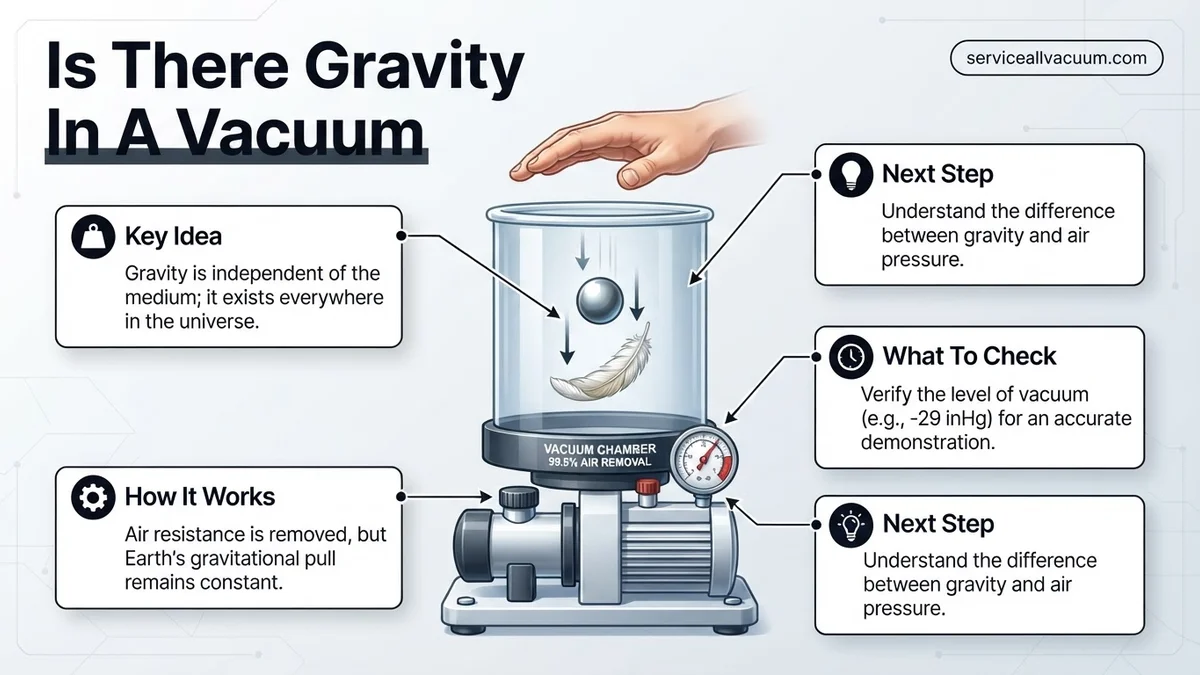
You can test the independence of gravity and air right here on Earth using a vacuum chamber. If you drop a heavy bowling ball and a light feather inside a normal room, air resistance makes the feather float down slowly while the bowling ball drops fast. People often confuse this air drag with gravity itself.
However, when scientists pump all the air out of the chamber to create a vacuum, something remarkable happens. Both the bowling ball and the feather fall at the exact same speed and hit the bottom at the exact same time. This proves two vital facts:
- Gravity pulls on all objects with the same acceleration regardless of their weight.
- Gravity works perfectly fine inside a complete vacuum without any air present.
Planetary Orbits in the Vacuum of Space
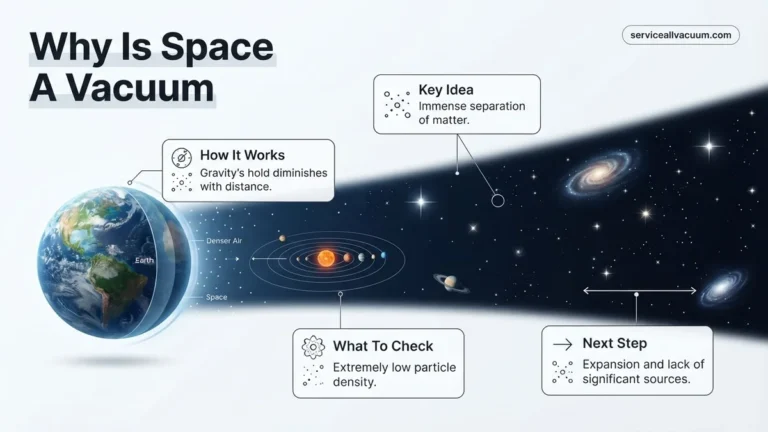
Look up at the night sky or consider the solar system in 2026. The Earth orbits the Sun, and the Moon orbits the Earth, moving through the vast, near-total vacuum of interplanetary space. If gravity required air or a physical medium to push against, planets could never maintain their predictable orbits.
The invisible tether of gravity reaches across millions of miles of empty vacuum to keep planets locked on their paths. This proves on a cosmic scale that the absence of matter does not stop gravitational forces from acting.
What If You Experience Weightlessness in Space?
Many people confuse the absence of weight with the absence of gravity. When astronauts float inside the International Space Station, they experience apparent weightlessness, often called microgravity. This sensation leads to the common misconception that gravity does not exist in the vacuum of space.
The Reality of Free Fall
The International Space Station orbits Earth at an altitude of approximately 400 kilometers. At this distance, Earth exerts roughly 90 percent of the gravitational force felt on the surface. Astronauts float not because gravity is missing, but because they are in constant free fall around the planet.
Understanding the Trajectory
The spacecraft travels horizontally at about 28,000 kilometers per hour. As gravity pulls the station toward Earth, the station moves forward so fast that Earth curves away beneath it. According to NASA physics models for 2026, this perpetual orbital free fall creates the exact same physiological sensation as zero gravity.
How to Calculate Orbital Mechanics and Free Fall
Determining the gravitational pull and orbital velocity in a vacuum requires applying standard physics formulas established by Isaac Newton and refined by modern aerospace engineering. To compute these values accurately for any orbiting body, follow this structured analytical process.
Step-by-Step Calculation Procedure
- Identify the mass of the central celestial body (M) and the mass of the orbiting object (m), utilizing standard astronomical datasets updated for 2026.
- Determine the orbital radius (r) by measuring the distance from the center of mass of the primary body to the orbiting satellite.
- Apply Newton’s law of universal gravitation, using the gravitational constant (G), to calculate the attractive force operating through the vacuum: F = G (M m) / r^2.
- Compute the required orbital velocity (v) to maintain stable free fall using the formula v = sqrt(G * M / r), ensuring the object matches the curvature of the vacuum-bound trajectory.
What If It Still Doesn’t Work?
If your calculations for gravitational force or orbital mechanics yield unexpected results, standard troubleshooting steps can resolve the discrepancy. When theoretical models fail to match observed vacuum physics, utilize this fallback checklist:
- Verify that all distance measurements are converted to meters and masses are calculated in kilograms to prevent dimensional analysis errors.
- Account for relativistic corrections if calculating high-precision trajectories for modern 2026 satellite networks.
- Check your constant values, ensuring you use the precise gravitational constant (6.67430 x 10^-11 m^3 kg^-1 s^-2).
- Consult professional aerospace engineering software or institutional astrophysics databases if advanced computational anomalies persist.
- Engage a certified aerospace consultant or orbital mechanics specialist, with professional advisory services typically ranging from $150 to $350 per hour depending on complexity.
Conclusion
Gravity remains fully operational within a vacuum, acting independently of atmospheric pressure. The sensation of weightlessness in space is simply the result of continuous orbital free fall rather than a complete absence of gravitational pull. According to verified research and expert sources from leading space agencies, understanding this fundamental distinction clarifies the true mechanics of our universe. As a next step, apply the universal gravitation formula to test orbital velocities for different satellite altitudes today.
❓ Frequently Asked Questions
Does gravity get weaker the further you get from Earth?
Yes, gravitational force decreases with the square of the distance from the mass creating it. However, it never drops completely to zero no matter how far away you travel in the universe.
Can you create a vacuum on Earth where gravity stops working?
No, laboratory vacuum chambers remove almost all the air and gas particles, but gravity remains completely unaffected inside the chamber.
Why don’t planets get sucked into the sun if gravity pulls them?
Planets have high forward velocity, which creates a balance between the pull of gravity and their sideways motion, resulting in a stable orbit.
How did Isaac Newton explain gravity in a vacuum?
Newton described gravity as a force of attraction between any two masses that acts across a distance, even through the empty vacuum of space.
Does light get affected by gravity in a vacuum?
Yes, massive objects warp spacetime, which bends the path of light even when it travels through the vacuum of space, a phenomenon known as gravitational lensing.
Is there any place in the universe with zero gravity?
True zero gravity is theoretically impossible because every object in the universe exerts a gravitational pull on every other object, no matter how distant.