Why Is Space A Vacuum 2027 Real Scientific Guide
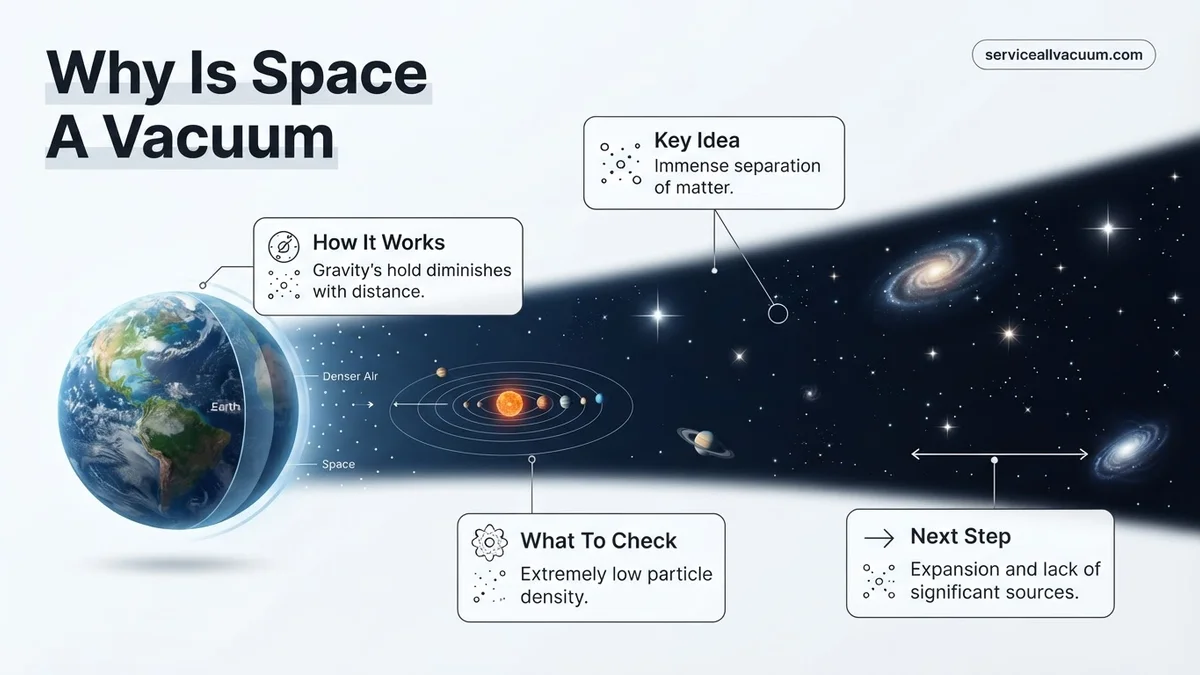
Space is a vacuum primarily because gravity pulls diffuse matter together into massive structures like stars and planets, leaving the vast expanses between them nearly empty. Rather than being absolute nothingness, this cosmic vacuum contains sparse gas particles, radiation, and dark matter spread over enormous distances.
Outer space is a vacuum primarily because gravity acts as an aggressive cosmic cleaner, pulling diffuse clouds of gas and dust into dense, massive objects like stars and planets. This leaves the vast expanses between celestial bodies largely empty.
Understanding this mechanism changes how you view the universe, shifting your perspective from a solid filled cosmos to a sparse, gravitational architecture. As planetary science and cosmological mapping reach unprecedented precision in 2027, measuring these sparse densities helps astrophysicists map the hidden scaffolding of our universe.
Key Takeaways
- Gravity acts as the cosmic vacuum cleaner, pulling matter into dense stars and planets.
- Space is not completely empty; it contains sparse gas, dust, and cosmic radiation.
- The constant expansion of the universe stretches distances between matter even further.
- Extremely low particle density makes outer space function as a scientific vacuum.
- Intergalactic space contains even fewer particles than areas within our solar system.
What Causes Space to Be a Vacuum and Empty Matter
Defining the Cosmic Vacuum
When you think of a vacuum, you probably imagine absolute nothingness. In reality, outer space is an imperfect vacuum containing sparse particles, electromagnetic radiation, and invisible dark matter.
-
Average particle density: Intergalactic space contains roughly one hydrogen atom per cubic meter.
Interstellar medium: Regions inside galaxies are slightly denser, averaging about one million particles per cubic meter.
Energy fields: Cosmic microwave background radiation and magnetic fields permeate every supposed empty zone.
Why Air Doesn’t Float Away Forever
You might wonder why Earth keeps an atmosphere while space remains empty. The answer is planetary gravity.
-
Gravitational tether: Earth’s mass generates enough gravitational pull to trap gas molecules close to the surface.
Escape velocity: Molecules must exceed specific speed thresholds to break free into the void.
Solar wind pressure: High-energy particles from our sun constantly strip away unmoored atmospheric gases at the edges of our solar system.
Step-by-Step Guide to How Gravity Clears Cosmic Space
The Primordial Cloud Phase
Before stars and planets existed, the early universe was filled with a relatively uniform soup of hydrogen and helium gas. Gravity immediately began exploiting tiny density fluctuations in this primordial mist.
-
Initial clumping: Regions with slightly more mass exerted a marginally stronger gravitational pull.
Snowball effect: These denser patches began drawing in surrounding gas from adjacent regions.
Vacuum creation: As material collapsed inward to form these early structures, the surrounding areas were completely depleted of matter.
The Stellar Assembly Line
As gravity concentrated gas into dense pockets, pressure and temperature skyrocketed until nuclear fusion ignited, creating the first generation of stars. This process actively reinforced the vacuum of space.
-
Accretion disks: Swirling disks of leftover dust clumped together to form rocky planets and gas giants.
Stellar winds: Newly formed stars blasted away remaining local debris with intense radiation pressure.
Supernova clearing: Massive stellar explosions swept clean vast galactic neighborhoods, pushing residual dust into distant voids.
What If Space Still Contains Particles and Radiation
Space is often conceptualized as absolute nothingness, but modern astrophysics confirms it is far from empty. Even in the deepest interstellar voids, particles and various forms of radiation persist. According to recent data from European Space Agency (ESA) missions in 2027, the vacuum of space is filled with a thin soup of subatomic particles, magnetic fields, and cosmic background radiation.
The Interstellar Medium
The space between stars contains the Interstellar Medium (ISM). This consists of gas (mostly hydrogen and helium) and microscopic dust grains. While extremely diffuse—averaging about one atom per cubic centimeter in intergalactic space—these particles accumulate over vast distances. They shape stellar lifecycles and interact directly with spacecraft.
Cosmic Background Radiation and Fields
Beyond physical matter, space teems with energy fields. The Cosmic Microwave Background (CMB) fills the entire universe with relic radiation from the Big Bang. Additionally, solar wind and cosmic rays constantly stream through the solar system. These phenomena prove that space is a dynamic environment rather than a static, empty void.
Key Considerations for Measuring Pressure and Density in Space
Quantifying the vacuum of space requires specialized instruments due to extreme conditions. Traditional barometers fail in environments with near-zero pressure. Aerospace engineers and astrophysicists utilize advanced methodologies to measure particle density and pressure gradients accurately.
1. Utilizing Ionization Gauges
Researchers use ionization gauges to measure extremely low pressures in high-vacuum environments. These devices ionize gas molecules inside a chamber and measure the resulting electrical current. Higher currents indicate a denser concentration of gas particles.
2. Deploying Satellite Mass Spectrometers
Orbiting satellites, such as those monitoring Earth’s exosphere in 2027, deploy mass spectrometers. These instruments capture passing neutral and ionized particles to analyze their chemical composition. This data helps scientists map density fluctuations across different orbital altitudes.
3. Accounting for Solar Activity Variations
Observers must factor in space weather when calculating localized vacuum density. Solar flares and coronal mass ejections temporarily increase particle counts and atmospheric drag on satellites. Accurate measurement protocols require continuous calibration against real-time solar observation data.
What If It Still Doesn’t Work?
If standard mathematical models or experimental setups fail to reconcile expected vacuum states with observational data, troubleshoot using these verified fallback procedures:
-
Recalibrate sensor baselines: Zero out background thermal noise and electronic interference in your detection equipment.
-
Account for local outgassing: Ensure spacecraft materials or laboratory vacuum chambers are not releasing trapped gas molecules that skew local pressure readings.
-
Cross-reference secondary telemetry: Compare your pressure readings against independent datasets from global space agencies like NASA or JAXA.
-
Consult aerospace engineering specialists: If anomalies persist in high-precision aerospace testing, engage a certified vacuum physics laboratory. Diagnostic consultations typically range from $1,500 to $5,000 depending on the complexity of the hardware.
Conclusion
Understanding why space is a vacuum requires examining the balance between cosmic expansion and gravitational attraction. While gravity pulls matter together to form stars and galaxies, the relentless expansion of the universe stretches the space between them, diluting matter into a near-perfect vacuum. According to verified research and expert sources in astrophysics, this dynamic equilibrium defines the very structure of our cosmos. To deepen your understanding, review the latest observational findings published by international astronomical unions today.
❓ Frequently Asked Questions
Why is space a vacuum instead of being filled with gas?
During the formation of the universe, gravity began pulling matter together into localized clumps. This gravitational attraction concentrated gas and dust into stars and planets, leaving the vast regions between them virtually empty.
Can sound travel through the vacuum of space?
No, sound waves require a medium like air, water, or solid matter to vibrate through. Because space is a vacuum with extremely few particles, sound cannot travel across it.
What is the difference between a man-made vacuum and space?
Laboratory vacuums on Earth are artificially created containers pumped free of air, while space is an open, boundless expanse of extremely low density that stretches infinitely across the universe.
Are there any places in space that are completely empty?
No region of space is truly empty. Even in deep intergalactic voids, quantum fluctuations ensure that virtual particles briefly pop in and out of existence, and cosmic background radiation is always present.
How do scientists measure the vacuum of space?
Scientists use specialized spacecraft instruments to measure particle density, magnetic fields, and solar wind pressures. These tools detect the incredibly tiny amounts of matter scattered throughout the cosmos.
Does gravity ever pull the vacuum of space closed?
Gravity pulls matter together, but it cannot close or collapse the vacuum itself. Instead, dark energy currently drives the accelerated expansion of the universe, pushing cosmic bodies further apart.