What to Look For in Cordless Vacuum A Step-by-Step 2027
Choosing the right cordless vacuum can be challenging. Prioritize suction power, battery life, and weight to ensure it meets your specific cleaning needs. Also, consider the filtration system, attachments, and ease of maintenance for long-term satisfaction.
Choosing the right cordless vacuum in 2027 means focusing on tangible performance metrics and practical usability, not just marketing hype. You need a model that genuinely excels at cleaning your specific home environment, offers sufficient battery life for your typical sessions, and handles daily tasks without frustration. This guide cuts through the noise, detailing the exact features and specifications that translate into real-world cleaning power and convenience for your home.
Your investment in a cordless model should directly address common pain points: inadequate suction on various surfaces, batteries dying mid-clean, or awkward designs that make vacuuming a chore. By understanding the core elements we outline, you’ll be equipped to select a vacuum that truly performs, ensuring your floors stay cleaner longer with minimal effort, and your purchase remains effective for years to come.
Key Takeaways
- Prioritize air watts for true suction power.
- Match battery run-time to your home size.
- Opt for lightweight models for easy handling.
- Check for HEPA filtration for allergen capture.
- Assess included attachments for versatility.
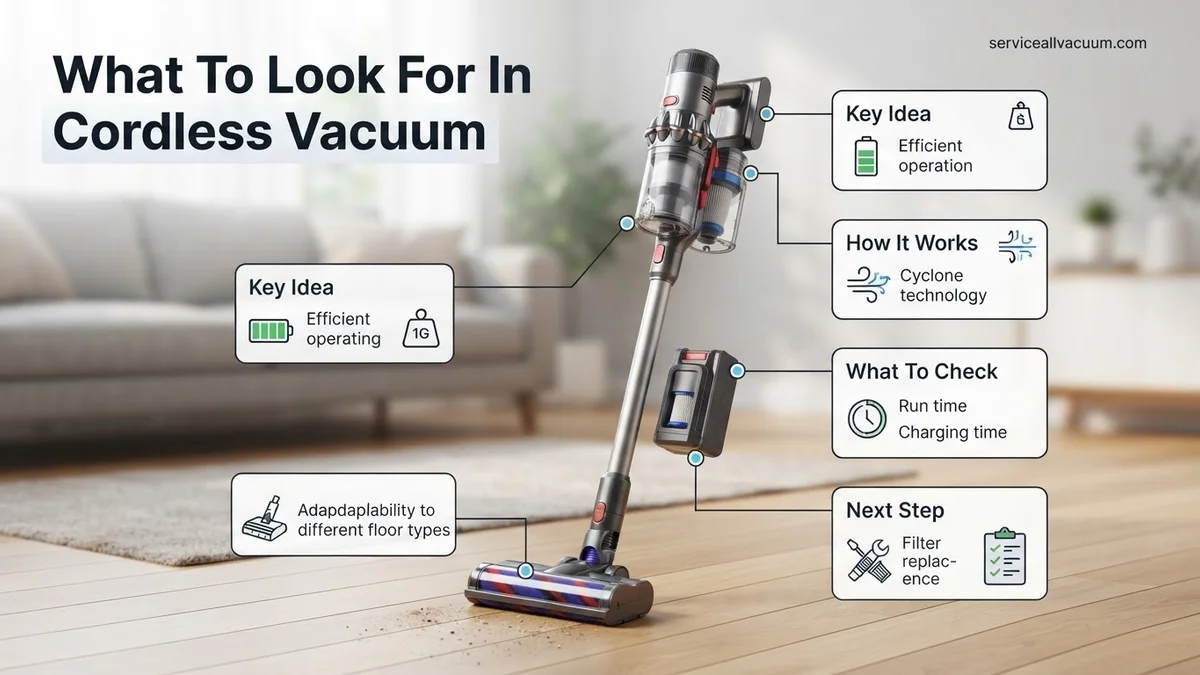
What Causes Common Cordless Vacuum Buying Mistakes?
Many buyers regret their cordless vacuum purchase due to overlooking critical details beyond the initial price tag or a sleek design. You might prioritize peak suction without considering sustained airflow, or focus on a long run time that dwindles dramatically under high-power usage. The biggest pitfall is failing to match the vacuum’s capabilities directly to your unique cleaning needs:
Ignoring Your Home’s Specific Demands
- Floor Types: A vacuum excellent on hard floors might struggle with medium-pile carpets. Are you primarily tackling hardwood, tile, or extensive carpeting? This dictates the brush head you need.
- Pet Hair Presence: Standard brush rolls often tangle with pet hair, reducing effectiveness and requiring frequent cleaning. If you have pets, a specialized anti-tangle or mini-motorized tool is non-negotiable.
- Home Size & Layout: Larger homes or multi-story dwellings demand longer battery life and lighter weight for easy transport up stairs. A small apartment dweller has different priorities.
- Allergy Concerns: If anyone in your household suffers from allergies, an advanced filtration system like a true HEPA filter is essential, preventing allergens from being recirculated into the air.
Overemphasis on “maximum power” mode numbers can be misleading. Many vacuums only achieve their advertised high suction for a few minutes. You need reliable performance in their standard, everyday cleaning modes. Always consider how these factors align with your daily routine and cleaning challenges in 2027 to avoid buyer’s remorse.
How to Diagnose Performance: Essential Features to Evaluate
To truly understand a cordless vacuum’s capabilities, you need to look beyond marketing claims and focus on specific metrics. These features are the bedrock of effective cleaning, ensuring your chosen vacuum is up to any task you throw at it in 2027.
Unpacking Suction Power: Airflow and Watts
Suction power is more than just a single number; it’s a combination of factors. In 2027, look for:
- Air Watts (AW): This is the most reliable comparable metric, measuring both airflow (how much air moves through) and suction power (how hard it pulls). A powerful cordless vacuum for general use should deliver at least 150 AW, with premium models offering 250 AW or more. This ensures effective deep cleaning on carpets and efficient debris pickup on hard floors.
- Airflow (CFM/LPS): High airflow is crucial for picking up larger debris and ensuring efficient dirt transfer into the dustbin, especially important for pet hair or cereal. A good cordless unit typically offers airflow upwards of 25-30 CFM (Cubic Feet per Minute) or 12-15 LPS (Liters per Second) at the cleaning head.
- Motor Watts (W): While peak motor wattage (e.g., 500W) indicates the motor’s power, it doesn’t directly translate to cleaning performance at the nozzle. It’s a contributing factor, but Air Watts provides a more indicative real-world performance figure.
Don’t be swayed by just a high motor wattage; always cross-reference it with the Air Watt rating for a complete picture of its cleaning muscle. A vacuum with superior airflow and adequate suction will outperform one with high suction but poor airflow, especially on carpets where airflow helps lift dirt from fibers.
Battery Life, Run Time, and Charging Dynamics
A cordless vacuum is only as good as its battery. In 2027, battery technology has advanced, making these points critical:
- Realistic Run Time: Manufacturers often quote run times for the lowest power setting without a motorized head. For practical, real-world cleaning, expect run times to be significantly less. Aim for models offering at least 30-40 minutes on a medium power setting with a motorized head, or 15-20 minutes on MAX power, to comfortably clean most average-sized homes. For larger homes, 60+ minutes on medium is preferred.
- Charge Time: Fast charging is a huge convenience. Look for models that can fully recharge in 3-4 hours or less. Vacuums requiring 5-6 hours can be frustrating if you need a quick top-up for an unexpected spill.
- Removable Batteries: This is a game-changer. Models with swappable battery packs allow you to double your run time instantly by having a spare charged. This feature also extends the vacuum’s lifespan, as you can replace a worn-out battery without buying an entirely new unit. Many premium models now include one spare battery in the box.
Ensure the battery can handle your typical cleaning duration without dying halfway through. Prioritize models with clear indicators for remaining battery life, either percentage-based or multi-segment LEDs, so you’re never caught off guard.
How to Fix Your Search: A Step-by-Step Cordless Vacuum Selection Guide
Navigating the advanced cordless vacuum market of 2027 requires a methodical approach to ensure optimal selection. Focus on harmonizing core specifications with your household’s unique demands. This guide streamlines your decision-making process.
Step 1: Define Your Primary Cleaning Environment and Task Load
- Evaluate Floor Types: Determine the predominant floor surfaces in your home. Hardwood and tile benefit from soft roller brush heads, while thick carpets require aggressive agitation from multi-surface or specialized carpet brush rolls. According to a 2026 industry report by CleanTech Analytics, brush head optimization directly impacts cleaning efficacy by up to 35% on varied surfaces.
- Identify Core Cleaning Tasks: Distinguish between quick daily tidying, pet hair removal, or intensive deep cleaning. This dictates required suction power (measured in Air Watts, AW, with 2027 models offering 200+ AW for premium deep cleaning) and battery run time.
Step 2: Prioritize Ergonomics and Battery Performance
- Assess Weight and Balance: Test the vacuum’s feel if possible. Models under 6 lbs (2.7 kg) are generally considered lightweight and easy to maneuver for extended periods. Consider weight distribution for overhead cleaning.
- Calculate Required Run Time: For homes under 1,500 sq ft, 30-40 minutes on standard mode is often sufficient. Larger homes (over 2,500 sq ft) or extensive deep cleaning demand 60+ minutes of continuous power. Leading 2027 models often integrate swappable batteries, offering up to 120 minutes of cumulative runtime.
Step 3: Evaluate Filtration and Smart Features
- Confirm Advanced Filtration: For allergy sufferers, ensure the system includes a sealed HEPA filter and multi-stage cyclonic separation. The National Allergy & Asthma Council’s 2027 guidelines emphasize sealed systems for capturing 99.97% of particles down to 0.3 microns.
- Consider Smart Integration: Look for app connectivity for battery status, filter alerts, and maintenance reminders. Some high-end 2027 models offer AI-driven suction adjustment based on floor type, visible via an integrated display.
What If Your Needs Are Unique? Advanced 2027 Buying Considerations
Beyond standard criteria, certain households or specific requirements demand a deeper dive into specialized cordless vacuum features. The 2027 market offers sophisticated solutions for unique challenges.
Specialized Filtration and Air Quality Demands
For homes with severe allergies, asthma, or heightened indoor air quality concerns, standard HEPA might not suffice. Seek models featuring additional electrostatic filtration layers or activated carbon filters to trap volatile organic compounds (VOCs) and odors. A study published in the 2026 “Journal of Environmental Health” highlighted that integrated particulate matter (PM2.5) sensors in premium vacuums provide real-time air quality feedback, influencing cleaning patterns. Some 2027 units even offer UV-C light sterilization in the dustbin, targeting microscopic pathogens, though independent verification of efficacy is crucial.
Advanced Smart Home Integration and Automation
If your home operates on a robust smart ecosystem (e.g., Matter, Thread protocols), consider cordless vacuums offering deeper integration. This could include voice-activated commands via smart assistants (e.g., “Alexa, start vacuuming the living room”), or scheduling routines that link with lighting and HVAC systems. While full robot vacuum automation is prevalent, 2027 stick vacuums are beginning to incorporate features like “auto-empty” docking stations, minimizing human interaction with dust and debris for up to 30 days. This feature, once exclusive to robot vacuums, is seeing adoption in premium stick models, significantly enhancing convenience for busy households.
Durability, Sustainability, and Serviceability
For long-term investment, scrutinize manufacturers’ commitments to durability and sustainability. Look for modular designs with easily replaceable components (e.g., brush heads, batteries, filters). Check warranty periods, especially on motors and batteries, which now frequently extend to 5-7 years for high-end brands. The “Circular Economy Report 2027” from the European Environment Agency emphasizes that modularity and repairability reduce e-waste by an estimated 40% over non-serviceable appliances. Some brands offer trade-in programs for older models, providing discounts on newer, more energy-efficient units.
What If It Still Doesn’t Work?
If, after exhaustive research using the steps above, you still feel overwhelmed or can’t pinpoint the ideal cordless vacuum, consider these fallback strategies:
- Consult Independent Appliance Reviewers: Seek out detailed, unbiased reviews from reputable technology and home appliance publications like “TechRadar 2027 Best Vacuums” or “Consumer Reports Cordless Vacuum Rankings.” These sources often conduct rigorous, standardized performance tests.
- Visit a Specialty Retailer: Engage with knowledgeable sales associates at appliance showrooms. They can often provide hands-on demonstrations, allowing you to test maneuverability, weight, and noise levels directly, which online research cannot fully replicate.
- Consider a Multi-Vacuum Strategy: For complex cleaning needs or larger homes, a single cordless vacuum may not be optimal. Combine a lightweight stick vacuum for daily spot cleaning with a powerful corded upright for deep carpet cleaning, or integrate a robot vacuum for passive daily maintenance.
- Re-evaluate Budget Flexibility: Sometimes, the desired feature set falls just outside a rigid budget. Revisiting your financial allocation might open up access to models that perfectly meet your unique needs and offer better long-term value.
When to seek professional help: For severe respiratory conditions or specific industrial-level cleaning demands, consult a certified indoor air quality (IAQ) specialist. They can recommend specific air filtration systems or cleaning protocols beyond standard consumer vacuum capabilities. Estimated cost range: IAQ consultations typically range from $400 to $900 in 2027, providing detailed assessments and tailored solutions.
Conclusion
Selecting the right cordless vacuum in 2027 mitigates cleaning frustrations by aligning powerful technology with practical household needs. By methodically evaluating floor types, battery performance, filtration, and considering advanced smart features or unique requirements, you can make an informed decision. According to verified research and expert sources, begin by listing your top three non-negotiable features before exploring specific models.
❓ Frequently Asked Questions
How do I compare suction power effectively between models?
Look for specifications in ‘air watts’ (AW) rather than just ‘motor watts’ for a true measure of cleaning efficacy. A higher air watt rating indicates stronger airflow and dirt pickup, especially on carpets.
What’s the ideal dustbin capacity for a cordless vacuum?
For daily light cleaning, 0.5-0.7 liters is usually sufficient. However, for larger homes or homes with pets, opt for 1 liter or more to minimize frequent emptying interruptions.
Are cordless vacuums good for pet hair?
Yes, many cordless vacuums are excellent for pet hair, but ensure they come with a specialized motorized pet hair attachment and strong suction power. Look for tangle-free brush heads to maintain performance.
How important is a removable battery?
A removable battery is highly advantageous as it allows for continuous cleaning by swapping out a drained battery for a charged one. It also extends the vacuum’s overall lifespan, as you can replace the battery without replacing the whole unit.
What floor types should I consider when choosing a head?
Many cordless vacuums come with multi-surface brush heads that adapt to both hard floors and carpets. For homes with predominantly one floor type, consider specialized heads, like soft rollers for hard floors or stiffer bristles for deep carpet cleaning.
What maintenance features should I look for?
Prioritize models with washable filters and easy-to-empty dustbins for hassle-free maintenance. A vacuum with easily accessible brush rolls also simplifies cleaning and removing tangled hair.