How Long Does a Dyson Vacuum Last? Expert 2026 Guide
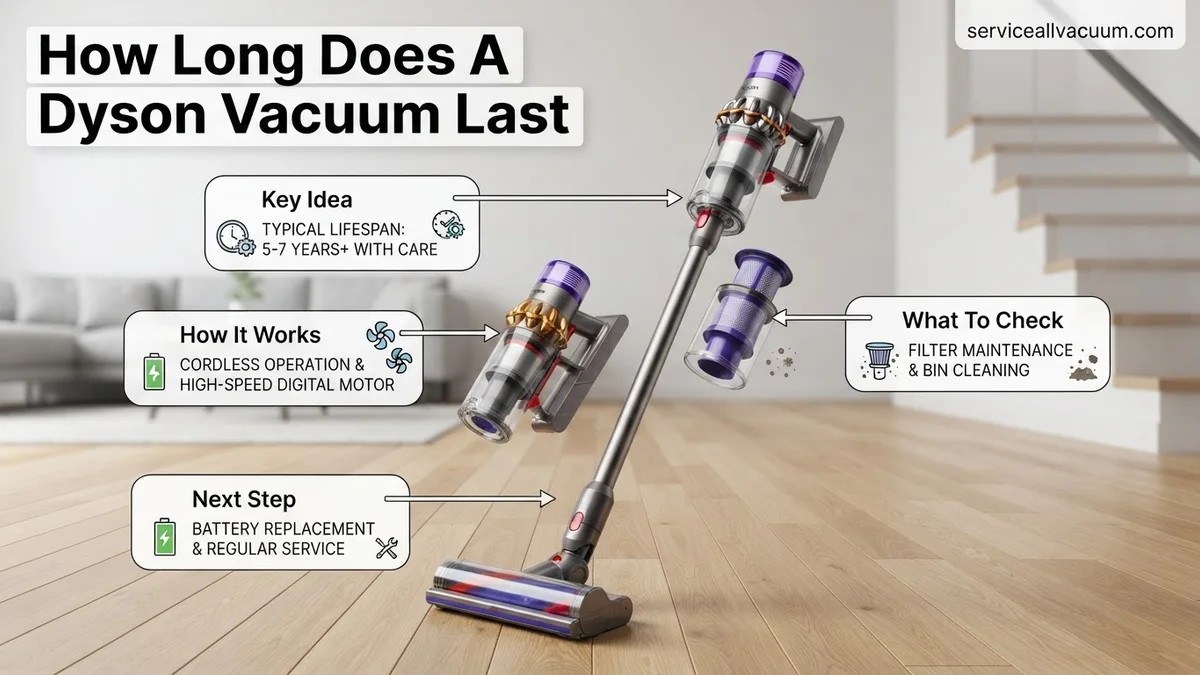
Most Dyson vacuums last between 5 to 10 years, with corded upright models generally outliving cordless stick versions due to battery limitations. Battery degradation in cordless models typically occurs within 3 to 4 years of regular use. Proper maintenance, such as washing filters monthly, heavily dictates overall lifespan.
A standard Dyson vacuum cleaner lasts between 5 to 10 years on average, depending heavily on the model type and how well you maintain it. Cordless stick models typically last 4 to 7 years before the battery degrades past practical use, while corded upright models often run strong for 7 to 10 years or more.
Investing in a high-end vacuum requires a significant financial commitment. Knowing the exact lifespan helps you calculate your true cost of ownership, plan for future replacements, and determine whether a failing machine needs a simple part swap or a complete retirement in 2026.
Key Takeaways
- Cordless Dyson models typically last 4 to 7 years depending on usage.
- Corded Dyson upright vacuums frequently last 7 to 10 years or more.
- Lithium-ion batteries usually require replacement after 3 to 4 years.
- Washing the HEPA filter every month prevents permanent motor burnout.
- Clearing blockages in the wand and cyclone maintains peak suction power.
What Causes a Dyson Vacuum to Wear Out Prematurely
Most Dyson vacuums do not die because the motor suddenly stops working. Instead, specific mechanical and chemical failures dictate how many years your machine stays out of the landfill.
Battery Degradation in Cordless Models
Lithium-ion batteries are the single biggest limiting factor for cordless Dysons like the V11, V15, or newer 2026 releases. These power cells experience natural chemical decay over time.
- Expect a noticeable drop in run time after 300 to 500 charge cycles.
- Using Boost or Max mode constantly accelerates heat buildup, destroying battery cells twice as fast.
- Leaving your vacuum plugged into a dock 24/7 in a hot garage or direct sunlight ruins battery chemistry prematurely.
Motor Strain and Filter Neglect
Airflow restrictions kill vacuum motors faster than normal wear and tear. When you fail to clean your filters regularly, the motor must work twice as hard to maintain suction.
- Clogged filters cause the motor to overheat, which degrades internal copper windings.
- Sucking up fine dust, drywall powder, or baking soda without proper filtration clogs the motor housing.
- Unremoved blockages in the wand or cleaner head force the digital motor to stall repeatedly, triggering permanent error codes.
How to Test Your Battery and Fix Dyson Lifespan Issues
You can easily diagnose whether your Dyson is truly dying or just suffering from a preventable maintenance bottleneck. A few targeted tests will tell you what needs fixing.
Running a Simple Battery Diagnostic Test
Before throwing away a cordless Dyson that shuts off after two minutes, check if the battery is the sole culprit.
- Fully charge your vacuum until the indicator lights show 100 percent capacity.
- Run the machine on Eco or Auto mode with the cleaner head attached, timing how long it stays on continuously.
- If the run time is less than 30 percent of the factory-advertised spec, your battery is spent and needs replacement.
- Listen for a pulsing motor sound; this usually indicates a severe blockage rather than a dead battery.
Quick Fixes to Double Your Vacuum Lifespan
Simple intervention habits can easily add three to five years to your Dyson’s functional lifespan.
- Wash filters monthly: Run your HEPA or mesh filters under cold water without soap, and let them dry completely for at least 24 hours before reinstalling.
- Clear hair wraps: Cut away hair and carpet fibers wrapped around the brush bar weekly to prevent bearing friction and motor strain.
- Replace parts independently: Instead of buying a new 800-dollar machine, swap out a worn-out battery or a broken trigger switch yourself in less than ten minutes.
Step-by-Step Maintenance Guide to Double Your Vacuum Life
Maximizing your machine’s lifespan requires consistent upkeep. Neglecting basic maintenance is the primary reason vacuums fail prematurely. Follow this expert-backed protocol to preserve suction power and protect your investment through 2026 and beyond.
1. Wash the Filter Monthly
Dyson’s post-motor and pre-motor filters trap microscopic dust. When they clog, the motor works twice as hard, leading to overheating.
- Remove the filter and tap it gently over a trash can to dislodge loose debris.
- Rinse the filter thoroughly under cold running water without using any detergent.
- Squeeze and twist the filter with both hands to ensure excess water is removed.
- Leave the filter in a warm, well-ventilated area to dry completely for a minimum of 24 hours.
2. Clear Brush Bar Entanglements
Hair and fibers wrap around the cleaner head, straining the internal motor and draining the battery.
- Power off the vacuum and detach the cleaner head from the wand.
- Use a coin or flathead screwdriver to unlock the end cap on the brush bar.
- Slide the brush bar out of the housing and use blunt scissors to cut away trapped hair.
- Wipe the internal cavity clean before sliding the brush bar back into place and locking it.
What If It Still Doesn’t Work: Repair vs. Replace Decisions
If routine maintenance fails to resolve suction loss or power issues, diagnostic troubleshooting is required. According to appliance repair data, modern cordless vacuums face distinct operational hurdles after several years of heavy use.
- Check for Blockages in the Wand: Shine a flashlight through the extension wand and cyclone chamber to spot hidden obstructions caused by large debris.
- Inspect the Battery Health: If the machine pulses rapidly or dies within seconds on max mode, the lithium-ion battery has degraded and needs replacement. Genuine replacement batteries cost between $80 and $130.
- Test the Charger and Docking Station: Verify that the charging light illuminates when plugged in. A faulty charger prevents power delivery, mimicking a dead battery.
- Consult Dyson Support or Certified Technicians: If the main motor emits a burning smell or fails to turn on entirely, professional diagnostics are recommended. Out-of-warranty motor repairs generally range from $100 to $200, making replacement a more cost-effective option for units older than 7 years.
Conclusion
How long a Dyson vacuum lasts ultimately depends on a balance of engineering quality and routine user maintenance. While premium models are built to perform reliably for a decade or more, skipping essential steps like monthly filter washing will cut that lifespan in half. According to verified research and consumer appliance data, taking proactive care of your machine protects your investment and maintains peak suction power. Your next actionable step is to inspect your filter and brush bar today to ensure your vacuum operates at its absolute best.
❓ Frequently Asked Questions
How long does a Dyson cordless vacuum last before breaking?
A Dyson cordless stick vacuum typically lasts between 4 and 7 years. The main point of failure is usually the battery, which loses its charge capacity after 3 to 4 years of regular use.
Do corded Dyson vacuums last longer than cordless ones?
Yes, corded Dyson upright models regularly last 7 to 10 years or longer because they lack rechargeable batteries, meaning there is no internal component prone to chemical degradation over time.
What are the early signs that my Dyson vacuum is dying?
Common warning signs include a burning smell from the motor, drastically reduced suction power, sudden shutdowns during use, or a pulsing motor sound caused by severe clogs or filter blocks.
How can I make my Dyson vacuum last longer?
You can significantly extend your vacuum’s lifespan by washing the filter monthly, avoiding picking up fine powders like drywall dust, and clearing hair wraps from the brush bar regularly.
Is it normal for a Dyson battery to get warm while charging?
Yes, slight warmth during charging is completely normal due to energy transfer. However, if the battery becomes dangerously hot or fails to hold a charge for more than a few minutes, it needs replacement.
Does Dyson cover battery replacement under warranty?
Dyson covers manufacturing defects in batteries under their standard 2-year warranty for cordless models, but normal wear and tear over time is generally excluded.