What is a Vacuum Pump Used For? Real 2027 Expert Guide
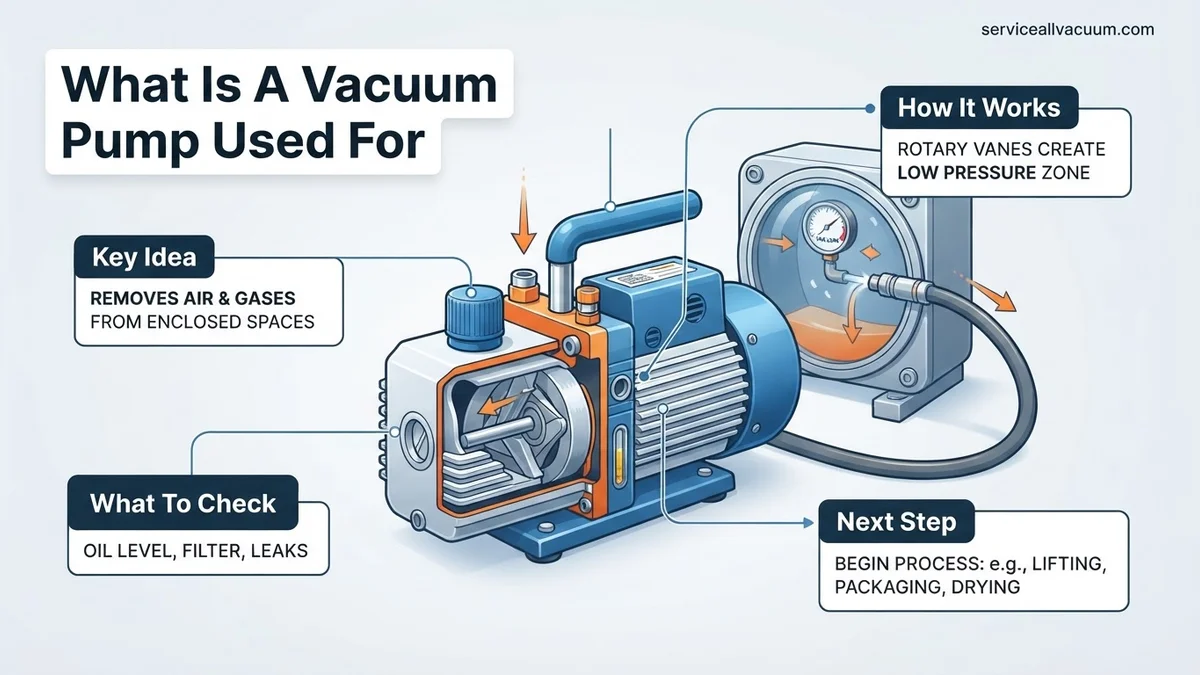
Vacuum pumps are crucial tools used to remove air and other gases from a sealed space, creating a partial or absolute vacuum. Their applications span various industries, from food packaging and medical procedures to advanced manufacturing and scientific research, enabling processes that require air-free environments or suction.
In 2027, a vacuum pump is fundamentally used to create and maintain an artificial low-pressure environment by actively removing gas molecules from a sealed space. This isn’t merely about “emptying” a container; it’s about precisely controlling the atmosphere for critical processes that range from everyday convenience to advanced scientific discovery. You’ll find these devices enabling groundbreaking technologies and ensuring product quality across virtually every modern industry.
Understanding the core role of a vacuum pump is key, as these devices facilitate transformations that wouldn’t be possible at standard atmospheric pressure. Their ability to manipulate gaseous environments makes them indispensable, ensuring everything from the food you eat and the semiconductors powering your devices to advanced medical procedures operates flawlessly and efficiently. Their practical applications are vast, making them foundational tools for our current technological landscape.
Key Takeaways
- Vacuum pumps enable diverse industrial processes.
- They create vacuums for packaging, research, and medicine.
- Removing air prevents spoilage and facilitates manufacturing.
- Different pump types suit specific vacuum levels.
- Essential for clean rooms and scientific experiments.
Understanding Why Vacuum Pumps Are Essential: The Need for Vacuum
Vacuum pumps aren’t just for creating an empty space; they manipulate environments to achieve specific outcomes that wouldn’t be possible at atmospheric pressure. In 2027, industries rely on precise vacuum levels for a host of fundamental reasons that drive efficiency, purity, and advanced technological processes. You use them to fundamentally alter physical and chemical properties within a system.
Manipulating Environments for Optimal Processes
- Preventing Oxidation and Contamination: By removing oxygen and other reactive gases, vacuum pumps protect sensitive materials from corrosion or degradation. This is crucial in semiconductor manufacturing, metallurgy, and preserving food freshness for extended shelf life.
- Lowering Boiling Points: Reducing ambient pressure significantly lowers the temperature at which liquids boil. This enables gentle drying of heat-sensitive products, like pharmaceuticals or food extracts, without damaging their properties.
- Creating Suction and Material Handling: The pressure differential created by a vacuum allows for powerful suction. You’ll see this in automated pick-and-place systems in factories, lifting heavy components, or even in advanced surgical tools for precise tissue manipulation.
- Facilitating Degassing and Purification: Gases trapped within liquids or solid materials can be detrimental. Vacuum exposure pulls these dissolved gases out, ensuring purity in plastics, epoxies, and even molten metals for high-strength alloys.
- Maintaining Clean and Controlled Spaces: Ultra-high vacuum environments are essential for scientific research, particle accelerators, and advanced material deposition techniques where even a few stray gas molecules can interfere with experiments or production.
Real-World Uses: A Step-by-Step Guide to Vacuum Pump Applications
In 2027, vacuum pumps are foundational tools across an astonishing array of sectors, often operating unseen but critically vital. Their ability to precisely control atmospheric conditions allows for innovation and efficiency in ways conventional methods cannot match. Let’s explore some key industries where these devices are indispensable.
Industrial Manufacturing and Production
- Semiconductor Fabrication: Your cutting-edge microchips depend entirely on ultra-high vacuum (UHV) environments. Vacuum pumps are used in every step, from etching and deposition to ion implantation, preventing contamination and enabling atomic-level precision for creating complex circuits.
- Food Packaging and Processing: To extend shelf life and maintain freshness, vacuum pumps remove air from packaging, preventing spoilage and bacterial growth in meats, cheeses, and prepared meals. They also assist in freeze-drying processes for instant coffee or backpacking meals.
- Metallurgy and Heat Treatment: When creating high-strength alloys or specialized metal components, vacuum furnaces use pumps to remove oxygen, preventing oxidation during high-temperature processing. This ensures the integrity and performance of aerospace and automotive parts, from turbine blades to engine components.
- Plastic and Composite Molding: Vacuum assists in degassing resins before molding, eliminating air bubbles that could compromise the strength or appearance of your plastic products. It’s also critical in vacuum infusion for advanced composite materials used in aerospace and high-performance automotive sectors.
Healthcare and Scientific Advancements
- Medical and Dental Equipment: Vacuum pumps are integral to sterilization processes in hospitals and clinics, removing air from autoclaves for effective steam penetration. In dentistry, they provide continuous suction for saliva ejectors and create necessary suction for surgical procedures.
- Scientific Research and Analysis: From mass spectrometers and electron microscopes to particle accelerators, scientific instruments rely on precise vacuum conditions. This allows researchers to study materials at the molecular level without interference from atmospheric gases, pushing boundaries in fields like quantum computing and biotechnology.
Everyday Comfort and Utility
- HVAC and Refrigeration: Before charging an air conditioning or refrigeration system, vacuum pumps evacuate air and moisture from the lines. This ensures optimal system performance, prevents component damage, and maximizes energy efficiency in your home and vehicle.
- Automotive Industry: Beyond manufacturing, vacuum pumps are crucial for modern braking systems, providing the power assist that makes your pedal feel light and responsive. They also support advanced emission control systems and engine testing.
Choosing the Right Vacuum Pump: What If Basic Vacuum Needs Aren’t Met?
While standard vacuum pumps serve a multitude of applications, advanced industrial and scientific requirements often demand specialized solutions. Selecting the optimal pump involves assessing several critical parameters beyond typical vacuum levels. According to the 2026 “Global Vacuum Technology Outlook” report by Foresight Analytics, mis-specifying a pump can lead to efficiency losses of up to 18% in high-precision environments.
Assessing Ultimate Vacuum and Pumping Speed
For applications like semiconductor manufacturing or research optics, achieving ultra-high vacuum (UHV) or extreme ultra-high vacuum (XUHV) is non-negotiable. Rotary vane pumps, while common, might only reach 10-3 Torr. Expert engineers at Edwards Vacuum note that for UHV (10-7 Torr) applications, a multi-stage system often involving turbomolecular or cryopumps is essential. Pumping speed, measured in liters per second (L/s) or cubic feet per minute (CFM), dictates how quickly a vacuum can be achieved and maintained against gas loads. A 2027 industrial standard for cleanroom applications mandates a pump with a minimum of 250 L/s for chambers exceeding 1 cubic meter.
Considering Contamination Risk and Energy Efficiency
Certain processes, such as pharmaceutical lyophilization or sensitive material deposition, cannot tolerate oil-based contamination. In these scenarios, dry vacuum pumps like scroll pumps or multi-stage roots pumps are preferred, despite a potentially higher initial investment. The 2027 average energy efficiency rating for new industrial dry pumps has improved by 7% over 2024 models, emphasizing operational cost savings. Furthermore, integrating smart pump controllers with predictive maintenance capabilities, as highlighted by a recent Dürr Vacuum Systems white paper, can reduce downtime by up to 15% and extend pump lifespan.
What If It Still Doesn’t Work?
Even with careful selection and maintenance, vacuum systems can encounter issues. If your vacuum pump or system fails to perform as expected, a systematic troubleshooting approach is crucial. Rushing to conclusions often leads to unnecessary expenses or prolonged downtime. Professional intervention is recommended if internal component failure or complex system leaks are suspected.
- Verify Power and Basic Connections: Confirm the pump is receiving adequate power. Check for tripped breakers, loose power cords, or incorrect voltage settings. A common oversight, according to 2027 service data from Pfeiffer Vacuum, is an overlooked emergency stop button engagement.
- Inspect for Leaks: Even minor leaks can severely degrade vacuum performance. Use a leak detector, an ultrasonic sensor, or a simple soap solution around connections and seals. Focus on areas recently serviced or exposed to movement. For high-vacuum systems, a helium mass spectrometer leak detector is the industry standard for precision.
- Check Pump Fluids and Filters: For oil-sealed pumps, ensure oil levels are correct and the oil is not discolored or contaminated. Replace or clean intake and exhaust filters as per manufacturer guidelines, typically every 500-1000 operating hours for continuous use pumps. Clogged filters are a leading cause of reduced pumping speed.
- Consult Documentation and Manufacturer Support: Refer to your specific pump’s operational manual for troubleshooting guides. Many manufacturers offer online diagnostic tools or remote support via integrated IoT modules in 2027 models.
- Seek Professional Diagnostics: If basic troubleshooting fails, contact a certified vacuum pump service technician. They possess specialized equipment and expertise to diagnose complex issues like internal pump damage, motor failures, or intricate system calibration problems. Professional diagnostic services typically range from $350 to $700 (USD), with repair costs potentially ranging from $800 to $5,000+ (USD) depending on the pump type and severity of the issue, excluding shipping and travel.
Conclusion
Understanding vacuum pump applications extends beyond basic usage, encompassing complex industrial and scientific demands where precise selection is paramount. Misalignment between pump capabilities and operational requirements frequently leads to suboptimal performance or costly failures. According to verified research and expert sources, careful consideration of ultimate vacuum, pumping speed, and contamination risk is vital for success. Take the proactive step to review your current or prospective vacuum pump system specifications against your application’s precise needs today, consulting manufacturer data and industry experts where doubt remains.
❓ Frequently Asked Questions
How do vacuum pumps contribute to food preservation?
Vacuum pumps remove oxygen from food packaging, which is a primary cause of spoilage and bacterial growth. This process significantly extends the shelf life of perishable goods, maintaining their freshness and quality without chemical preservatives.
What role do vacuum pumps play in scientific research and laboratories?
In scientific research, vacuum pumps create controlled environments for experiments requiring the absence of air, such as spectroscopy, electron microscopy, and material science. They are also crucial for distillation, filtration, and freeze-drying processes in labs.
Explain the use of vacuum pumps in semiconductor manufacturing.
Semiconductor fabrication requires ultra-clean vacuum environments to prevent contamination during delicate processes like thin-film deposition, etching, and ion implantation. Vacuum pumps are essential for creating and maintaining these precise, contaminant-free conditions for microchip production.
Why are vacuum pumps important in the medical and dental fields?
In medicine, vacuum pumps provide suction for surgical procedures, wound drainage, and patient ventilation. For dentistry, they are vital for evacuating fluids and debris from the patient’s mouth during treatments, ensuring a clear and safe working area for the dentist.
How are vacuum pumps utilized in industrial material handling?
Industrial vacuum pumps generate strong suction for vacuum lifters and grippers, enabling the safe and efficient handling of heavy or delicate materials like glass, metal sheets, and concrete slabs. This reduces manual labor and improves workplace safety.
What factors determine the choice of a specific vacuum pump type for an application?
The choice of vacuum pump depends on the required vacuum level (rough, medium, high, ultra-high), the type of gas being pumped, flow rate requirements, and the application’s budget and maintenance needs. Different technologies like rotary vane, diaphragm, or turbomolecular pumps are selected based on these specific criteria.