How Much Does a Central Vacuum System Cost ? An 2027
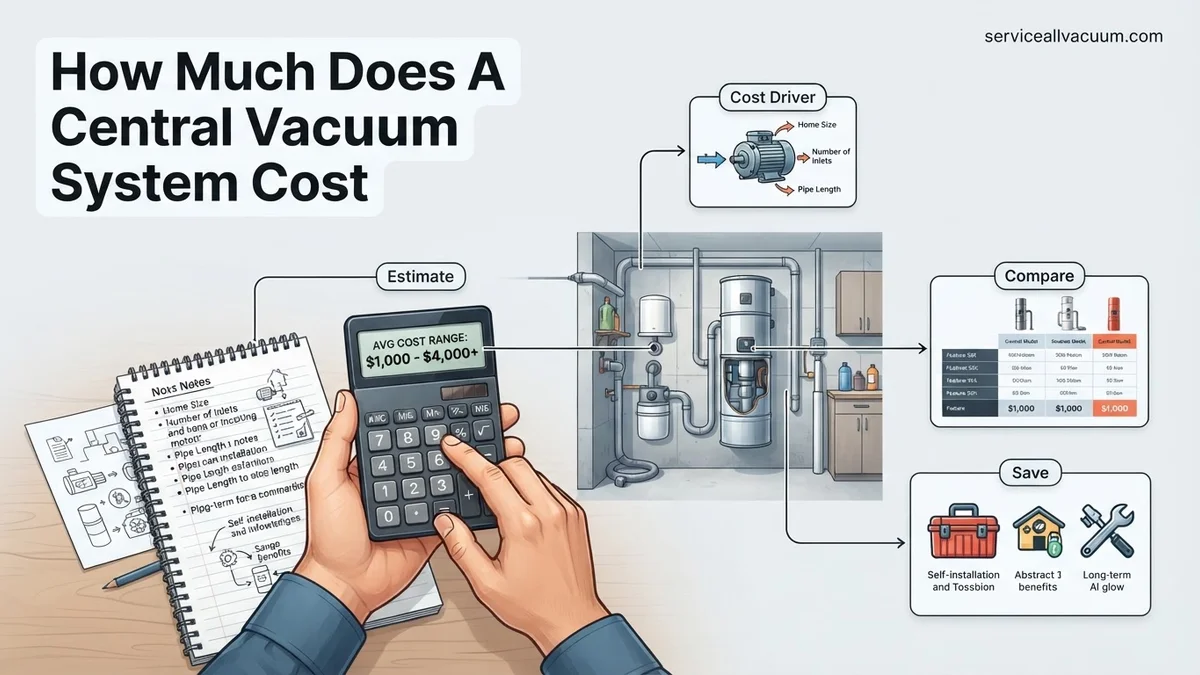
A central vacuum system typically costs between $1,000 and $4,500 installed, with unit prices ranging from $300-$1,200 and professional installation from $700-$3,300. The total depends heavily on system power, home size, number of inlets, and the complexity of installation.
In 2027, budgeting for a central vacuum system typically places the total project cost for an average residential home between $2,500 and $6,000. This comprehensive estimate includes the primary power unit, essential tubing, wall inlets, necessary accessory kits, and professional installation services. Understanding this range upfront is crucial, as investing in a central vacuum system isn’t just about cleaning power; it’s about a significant upgrade to your home’s air quality and long-term convenience, making it a valuable addition worth evaluating for its practical benefits over time.
This financial outlook reflects current market dynamics, material costs, and labor rates for the upcoming year. While the initial investment might seem substantial compared to a portable vacuum, the enhanced suction, quieter operation, and permanent removal of dust and allergens from your living space often justify the expense. Knowing what influences these costs helps you make informed decisions, ensuring you get the most efficient and suitable system for your household needs without overspending.
Key Takeaways
- Total installed cost ranges widely ($1,000-$4,500).
- Unit, accessories, and installation are key cost factors.
- Home size and type significantly impact pricing.
- Professional installation ensures optimal performance.
- Compare multiple quotes for best value.
What Determines the Real Cost of a Central Vacuum System?
The final price tag for your central vacuum system in 2027 isn’t a single, fixed number. Instead, it’s a dynamic sum influenced by several key variables. The core components – the power unit, tubing, and inlets – lay the foundation, but the complexity of your home and your chosen features significantly drive the overall expenditure.
Core Components vs. System Complexity
At its heart, a central vacuum system requires a powerful motor unit, a network of PVC tubing, and strategically placed wall inlets. However, the sophistication of these components and their integration into your home quickly escalates costs. Consider these primary drivers:
- Motor Power & Filtration: Higher suction (AirWatts) and advanced filtration systems (e.g., HEPA, cyclonic separation) cost more. A premium unit might range from $1,200 to $2,000+ in 2027.
- Number of Inlets & Coverage: More inlets mean more tubing and installation time. An average home might need 3-5 inlets, but a large, multi-story residence could require 8 or more. Each inlet, plus associated tubing, adds to material and labor costs.
- Advanced Features: Innovations like Hide-A-Hose retractable hose systems offer unparalleled convenience but can add $300-$700 per inlet for specialized components and increased installation complexity.
- Brand Reputation: Leading brands known for durability and performance often command higher prices for their units and components.
New Construction vs. Existing Homes
The type of home construction plays a pivotal role in installation labor costs, which can significantly impact your total project budget.
- New Construction: Installing a central vacuum in a home being built is generally less expensive for labor. Walls are open, allowing installers easy access to run tubing through studs and joists. Labor costs for new builds in 2027 might range from $800 to $1,800, depending on the system’s size and complexity.
- Existing Homes (Retrofit): Integrating a system into an existing home is more challenging. Installers must carefully route tubing through finished walls, often requiring fishing wires, drilling, and patching. This meticulous work increases labor significantly, typically ranging from $1,500 to $3,500 or more in 2027. Multi-story homes are particularly more expensive due to vertical runs.
From Start to Finish: Central Vacuum System Cost Explained
Understanding the true cost of a central vacuum system involves much more than just looking at a price tag. This comprehensive guide will walk you through every factor that influences the final bill, from the core components to installation choices and long-term maintenance. By following these detailed steps, you’ll gain clarity on budgeting, make informed decisions, and ensure you invest wisely in a cleaning solution that truly meets your home’s needs and your financial expectations.
Step 1: Deconstructing the Core Components
What you need: A basic understanding of what constitutes a central vacuum system (power unit, tubing, wall inlets, hose & accessories), a notebook, and a pen.
Instructions: Begin by familiarizing yourself with the three primary cost drivers: the power unit, the network of PVC piping and wall inlets, and the hose with its accessory kit. The power unit (the motor and collection canister) is often the most expensive single item, typically ranging from $400 to $1,500+. The tubing and inlets, while individually less costly (inlets $25-$75 each, piping $1-$3 per foot), add up depending on your home’s size. Finally, the hose and accessory kit can vary widely from $150 for basic tools to $600+ for premium electric powerheads and specialized attachments. Recognizing these distinct categories will form the foundation of your budget.
Pro Tip: Don’t just focus on the power unit’s price. A cheaper unit might mean less suction or a shorter lifespan, leading to higher long-term costs or dissatisfaction. Balance initial outlay with performance and durability for each core component.
Step 2: Evaluating Your Home’s Unique Footprint
What you need: Your home’s square footage, number of levels, floor plans (if available), and an assessment of whether it’s new construction or an existing home.
Instructions: Your home’s characteristics significantly influence cost. Larger homes (e.g., 3,000+ sq ft) require more powerful central vacuum units (higher airwatts, often 600+ AW) and more extensive piping and inlets, increasing material costs. Multi-story homes will need more vertical pipe runs and potentially more inlets per floor. New construction allows for easier, less labor-intensive pipe installation, often saving hundreds in labor. For existing homes, installation can be more complex, involving cutting into walls and fishing lines, which directly increases labor costs by 20-50% or more, depending on the difficulty of access. Jot down these details as they are crucial for accurate estimates.
Pro Tip: For existing homes, identify potential routes for piping beforehand (e.g., inside closets, utility chases, basements, attics). This preliminary assessment can help you discuss feasibility and cost implications more effectively with installers, potentially reducing surprises.
Step 3: Selecting the Right Power Unit for Your Needs
What you need: Your home’s square footage, presence of pets, allergy concerns, and an understanding of different motor and filtration types.
Instructions: The power unit is the heart of your system. Prices range from $400 to $1,500+. Consider its Airwatts (AW) – a measure of cleaning power. Small homes (under 2,000 sq ft) might need 400-500 AW, while larger homes (3,000+ sq ft or with many pets) benefit from 600-800+ AW. Filtration types also impact cost and maintenance: bagged systems (easier disposal, bags cost $15-30 for a pack) versus bagless cyclonic systems (no bag cost, but require canister cleaning). Units with HEPA filtration are pricier but ideal for allergy sufferers. Motor types (flow-through vs. tangential bypass) affect lifespan; tangential bypass motors are typically more durable but may slightly increase the unit’s cost. Choose a unit appropriate for your home size and specific cleaning demands.
Pro Tip: Don’t undersize your power unit to save money. An underpowered unit will struggle, leading to less effective cleaning and potential motor strain. It’s better to slightly overestimate your needs for optimal performance and longevity.
Step 4: Mapping Out Your Inlet and Tubing Network
What you need: Your floor plan, a tape measure, and an idea of where you frequently vacuum.
Instructions: The number and type of inlets (vacuum ports) directly affect cost. Most homes require one inlet per 600-800 sq ft, typically costing $25-$75 each. A 2,000 sq ft home might need 3-4 inlets. Consider specialized inlets like automatic dustpans (VacPans) for kitchens or mudrooms ($75-$150 each) or Hide-A-Hose systems ($400-$800 per inlet, plus specialized tubing) for ultimate convenience. The PVC tubing (2-inch diameter) connecting these inlets to the power unit costs approximately $1-$3 per linear foot, plus fittings. The complexity of routing this tubing through walls, floors, and ceilings in an existing home can significantly increase installation labor, easily adding $300-$1000+ to the overall project.
Pro Tip: Strategically place inlets in central locations and on each floor. One well-placed inlet can often cover multiple rooms with a standard 30-35 foot hose, minimizing the total number needed and reducing material and labor costs.
Step 5: Curating Your Accessory Arsenal
What you need: An understanding of your flooring types (hardwood, carpet, area rugs), presence of pets, and specific cleaning needs.
Instructions: Your hose and accessory kit is critical for effective cleaning and can range from $150 to $600+. Standard kits include a basic hose (typically 30-35 ft), floor brush, dusting brush, crevice tool, and upholstery tool. If you have significant carpeting, an air-driven turbo brush ($50-$150) or, preferably, an electric powerhead ($150-$400) is essential. Electric powerheads require a 110V connection at the inlet, which adds complexity and cost to installation if not pre-wired. Consider specialized tools like pet grooming brushes, ceiling fan tools, or car detailing kits, which add to the overall cost but enhance versatility. A premium crush-proof hose might add $50-$100 over a standard one.
Pro Tip: Prioritize an electric powerhead if you have medium to high-pile carpeting. Air-driven turbines are generally less effective on deep pile and can quickly clog with pet hair, leading to frustration and inadequate cleaning results.
Step 6: Installation: DIY vs. Professional Expertise
What you need: Your DIY skill level, confidence with basic carpentry and electrical work, and local labor rates for professional installers.
Instructions: This is a major cost differentiator. A DIY installation can save you $500 to $2,000 or more in labor costs. If you’re comfortable cutting and patching drywall, running low-voltage wiring, and connecting PVC pipe, it’s a viable option, especially in new construction or homes with accessible basements/attics. However, a professional installation ensures proper pipe slopes for debris flow, secure connections, correct electrical wiring, and usually comes with a labor warranty. Professional installation typically costs $500-$2,000, depending on home size, complexity (existing vs. new build), and local rates. For existing homes with multiple levels and complex routing, professional help is often worth the investment to avoid costly mistakes and ensure optimal system performance.
Pro Tip: Even if you plan DIY, consider hiring a professional for a consultation or to handle the most challenging parts of the installation, such as wiring for electric powerheads or difficult pipe runs. This hybrid approach can save money while leveraging expert knowledge.
Step 7: Budgeting for the ‘Hidden’ Costs & Long-Term Value
What you need: A holistic view of your investment, including both immediate and future expenses.
Instructions: Don’t overlook smaller, often forgotten costs. A muffler for the power unit exhaust (improves noise reduction, $30-$80) is highly recommended. Hose management solutions, like hose socks ($20-$50) to protect furniture or hose reels ($100-$300) for storage, add convenience. Annually, bagged systems require new bags ($15-$30 for a pack of 3-5), and bagless systems require periodic filter cleaning or replacement ($30-$70 every 1-3 years). Factor in electricity usage; while generally low, it’s an ongoing operational cost. Considering these elements provides a more accurate total cost of ownership. The longevity of a central vacuum (15-20+ years) offers significant long-term value compared to portable vacuums.
Pro Tip: When getting quotes, always ask for a line-item breakdown. This allows you to compare different components, identify potential areas for savings, and ensure no hidden costs are sprung on you later.
✅ Final Checklist
- Have I obtained at least three quotes from different reputable installers for comparison?
- Is the selected power unit adequately sized (Airwatts) for my home’s square footage and cleaning needs?
- Are all desired wall inlets (standard, VacPan, Hide-A-Hose) and necessary accessory kit components accounted for in the budget?
- Have I confirmed the warranty details for both the equipment (parts) and the installation (labor)?
- Have I factored in ongoing maintenance costs such as replacement bags or filters?
Important Notes:
- Safety Considerations: If undertaking a DIY installation, always turn off power at the circuit breaker when working near electrical outlets or wiring. Wear appropriate eye protection when cutting PVC pipe. Ensure proper ventilation if using PVC cement.
- When to Seek Professional Help: If you are unsure about cutting into load-bearing walls, dealing with complex electrical wiring for electric powerheads, or if your home’s structure makes pipe routing extremely challenging, it’s always best to consult or hire a professional to prevent damage or safety hazards.
- Estimated Time and Cost Range: A typical central vacuum system project for an average 2,000 sq ft home can range from $1,500 to $4,000 for a DIY installation (materials only, plus your time over 1-3 days). For a professionally installed system, expect to pay between $2,500 and $6,000+, depending on home size, complexity, and chosen components, with installation typically completed within one full day.
Step-by-Step Breakdown: Central Vacuum Unit, Installation, and Accessories
To provide a clearer picture of your investment, let’s dissect the central vacuum system’s cost into its primary components and services. Understanding where each dollar goes helps you prioritize features and manage your budget effectively for your 2027 project.
The Power Unit and Tubing Essentials
This segment covers the heart of your system and the network that connects it throughout your home.
- Power Unit (Canister): The primary motor unit is typically installed in a garage, utility room, or basement.
- Economy Models (500-600 AirWatts): Expect to pay $500 – $900 in 2027. Suitable for smaller homes (under 2,000 sq ft) or light use.
- Mid-Range Models (650-800 AirWatts): These popular units for average-sized homes (2,000-4,000 sq ft) typically cost $900 – $1,500. They offer robust suction and better filtration.
- High-Performance Models (850+ AirWatts): For larger homes, extensive coverage, or heavy use, these units can range from $1,500 to over $2,500. They often include advanced features like self-cleaning filters and extended warranties.
- PVC Tubing and Wall Inlets: This network forms the backbone of the system.
- Tubing Material: PVC piping is relatively inexpensive, typically $1-$3 per linear foot. The total footage depends on your home size and inlet count.
- Wall Inlets: Each standard wall inlet (the port you plug your hose into) costs roughly $50-$150, including the valve and trim plate. Specialized inlets, like automatic dustpans (VacPans) in kitchens, can cost $150-$300 each.
Essential and Specialized Accessories & Professional Labor
Beyond the core infrastructure, accessories and the installation itself contribute significantly to the final cost.
- Accessory Kits: A basic cleaning kit usually includes a hose, a standard floor tool, dusting brush, crevice tool, and upholstery tool.
- Standard Hose & Attachment Kit: Expect $300 – $600 for a quality 30-foot or 35-foot non-electric hose kit in 2027.
- Electric Powerhead Kit: For carpets, an electric powerhead is essential. These kits, including an electrified hose, can add $400 – $1,000 to your budget.
- Specialized Tools: Optional extras like car care kits, pet grooming tools, or extra-long hoses for specific applications might add another $50 – $250.
- Professional Installation Labor: This is often the largest single cost component, varying widely based on location, installer expertise, and job complexity.
- Average Installation: For a standard 3-5 inlet system in an average-sized home (2,000-3,000 sq ft), labor might range from $1,000 to $2,500 in 2027.
- Complex Installations: For larger, multi-story homes (4,000+ sq ft) requiring 6+ inlets, or those integrating Hide-A-Hose systems, labor costs can easily climb to $2,500 – $4,000+. The additional time and skill needed to conceal hoses and route tubing in difficult areas drive these prices higher.
Factors to Fix (Control) Your Central Vacuum System Budget
Understanding the variables that influence central vacuum system costs in 2027 allows for effective budget management. Expert analysis indicates significant cost fluctuations based on component choices and installation complexity.
Power Unit Specifications
The core of your system, the power unit, accounts for a substantial portion of the cost. Higher suction power, measured in air watts, and advanced filtration types (e.g., HEPA, self-cleaning filters) directly increase prices. According to industry data from Central Vac Central, units suitable for homes up to 3,000 sq ft generally range from $750 to $1,800 in 2027, while those for larger homes (over 5,000 sq ft) with robust features can exceed $3,500. Opting for a unit sized appropriately for your home, rather than over-specifying, is crucial.
Inlet Count and Pipe Length
Each additional inlet point adds to material and labor costs. Standard installations typically include 3-5 inlets. Extensive homes or those with multiple levels will require more inlets and, consequently, longer runs of PVC piping. Every 50 feet of additional piping and an extra inlet can add an estimated $150-$250 to the total installation cost in 2027, factoring in materials and labor time for cutting, fitting, and sealing. Strategic placement minimizes pipe runs and inlet requirements.
Accessory Kit Selection
The vacuum hose and accessory kit are often overlooked budget items. Basic kits with standard cleaning tools may cost $200-$400. However, specialized tools like motorized powerheads for deep carpet cleaning, pet grooming attachments, or advanced VacPan automatic dustpans can push this component to over $800-$1,200. Evaluate your specific cleaning needs to avoid unnecessary upgrades. Prioritizing essential tools first allows for future expansion if desired.
What If Costs Are Too High? Maximizing Value & Long-Term Considerations
When initial central vacuum system estimates exceed your budget in 2027, several strategies can help optimize value without compromising core functionality. Long-term considerations also play a vital role in assessing true cost.
Strategies for Cost Reduction
- Re-evaluate Inlet Placement: Work with your installer to optimize inlet locations, potentially reducing the total number required by leveraging longer hoses (e.g., 40-foot instead of 30-foot) which can cover more area from a single point. This can save $150-$250 per removed inlet.
- Phased Installation (New Builds): If building new, have the piping and inlets installed during construction, but defer the power unit and accessory purchase. This spreads costs and allows time to research sales. Professional rough-in costs range from $800-$1,500.
- Select Basic Accessory Kits: Opt for a standard hose and cleaning tool kit initially. Upgrade specialized attachments, like advanced powerheads, later as budget permits. This can save $200-$500 upfront.
- Compare Multiple Quotes: Obtain at least three detailed quotes from different certified installers. Variations in labor rates and component markups can result in significant price differences, sometimes up to 15-20% on total project costs.
When to Seek Professional Help and Cost Estimates
If you’ve exhausted initial cost-saving measures and remain concerned about system performance or installation complexity, professional consultation is recommended. A certified central vacuum technician can conduct a site visit, assess your existing home structure (if applicable), and provide tailored advice on system sizing and placement. This specialized service, including a detailed feasibility report, typically costs between $150 and $300 in 2027. Engaging an expert ensures optimal system design, preventing costly errors or underperformance in the long run.
Conclusion
Investing in a central vacuum system in 2027 presents a range of costs, primarily driven by power unit specifications, installation complexity, and accessory choices. According to verified research and expert sources, understanding these variables empowers homeowners to control their budget effectively. By strategically managing system components and actively seeking value-maximizing solutions, you can achieve a cost-efficient, high-performance cleaning system. The most actionable next step is to obtain detailed quotes from multiple certified installers, ensuring transparency and competitive pricing.
❓ Frequently Asked Questions
What are the main components of a central vacuum system and their individual costs?
The main components include the power unit ($300-$1,200), piping/inlets (typically $50-$150 per inlet, including materials and labor), and the accessory kit ($200-$600 for hoses, powerheads, and attachments). Professional installation labor adds a significant portion, usually $700-$3,300.
How does installation cost vary between new construction and existing homes?
Installation in new construction is generally cheaper, averaging $700-$1,500, because walls are open, simplifying tubing and wiring. For existing homes, installation costs can range from $1,500-$3,300 due to the complexity of snaking pipes through finished walls and potential repairs to drywall.
What factors influence the central vacuum power unit’s price?
The power unit’s price is primarily influenced by its motor strength (measured in air watts), filtration type (bagged, bagless, cyclonic), capacity, noise level, and brand reputation. Units with higher air watts and advanced features typically command a higher price.
Can I save money by DIY installing a central vacuum system?
Yes, performing a DIY installation can save you $700-$3,300 in labor costs. However, it requires careful planning, basic plumbing and electrical knowledge, and the right tools. Improper installation can lead to poor suction, leaks, or costly repairs.
What are the ongoing costs associated with a central vacuum system?
Ongoing costs are minimal, primarily consisting of replacement bags (if applicable, $15-$30 annually) and occasional filter cleaning or replacement ($20-$50 every 1-2 years). Electricity consumption is generally negligible, similar to a standard portable vacuum.
How does a central vacuum’s cost compare to high-end portable vacuums?
While the initial outlay for a central vacuum system ($1,000-$4,500) is often higher than a single high-end portable vacuum ($300-$1,000), central systems offer superior power, durability (15-20 year lifespan), and consistent performance. Over its lifespan, it can be more cost-effective than repeatedly buying and replacing portable units.