What is a Perfect Vacuum? Expert Guide 2027
A perfect vacuum is a purely theoretical concept of a region utterly devoid of all matter, energy, and fields, leading to zero pressure and absolute zero temperature. In reality, it’s impossible to achieve due to fundamental physics like quantum fluctuations and pervasive cosmic radiation.
A perfect vacuum is not just empty space; it’s a purely theoretical concept describing a region utterly devoid of everything. Imagine a volume containing absolutely no matter, no energy, no radiation, and no fundamental fields. This ideal state would exhibit zero pressure and precisely absolute zero temperature. Understanding this ultimate void helps us define the limits of what’s possible in advanced science and technology.
Achieving such an ultimate void drives significant innovation across various fields. From advanced materials science and manufacturing to cutting-edge quantum computing research in 2027, our pursuit of “better” vacuums informs crucial breakthroughs. Knowing the theoretical limit clarifies what is genuinely possible and what will always remain in the realm of abstraction.
Key Takeaways
- Perfect vacuum:no matter, energy, fields.
- Quantum physics prevents true vacuum.
- Cosmic radiation always present.
- Outer space is best natural approximation.
- Ultra-high vacuum is closest human-made.
What Exactly Is a Perfect Vacuum?
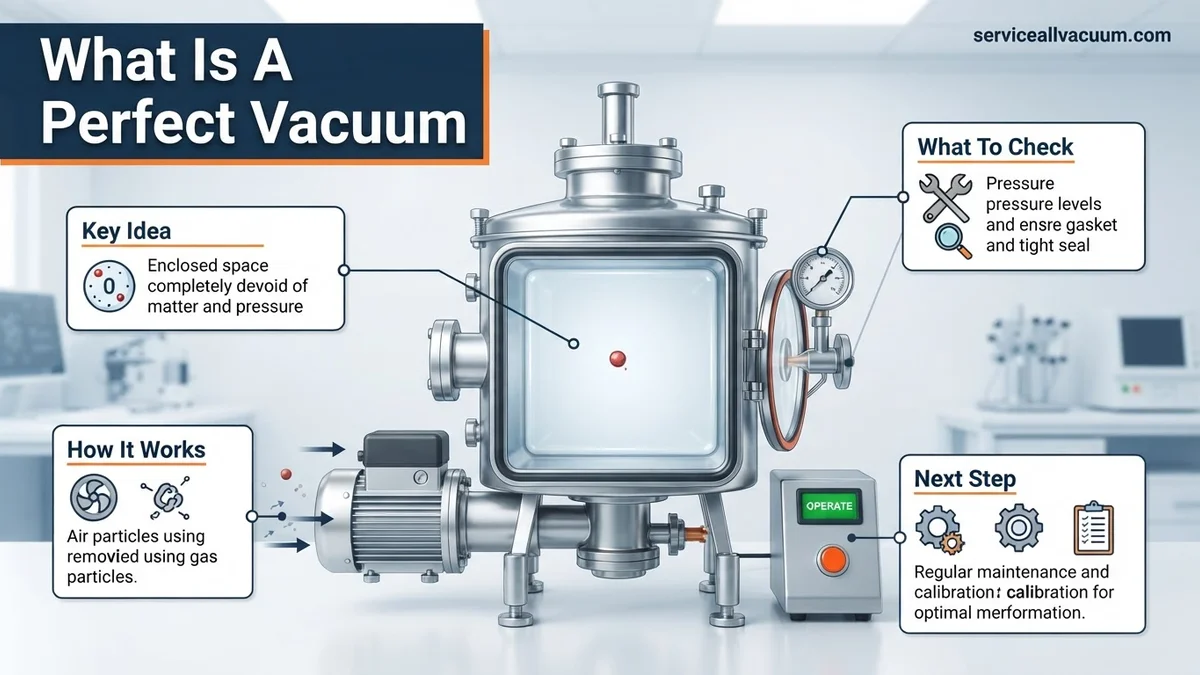
The concept of a perfect vacuum describes an utterly empty region of space. It represents the absolute absence of everything physical. Imagine a volume with literally nothing inside it. This includes all forms of matter, from atoms and electrons to subatomic particles. Crucially, it also means no energy in any form.
Defining Characteristics of the Void
- Zero Particle Density: Not a single atom, molecule, or even stray electron exists. The particle count is precisely zero.
- Absolute Zero Temperature (0 Kelvin): With no particles to move or vibrate, there is no thermal energy. This is the theoretical minimum temperature where all classical particle motion ceases.
- Zero Pressure: Pressure arises from particles colliding with surfaces. In a perfect vacuum, there are no particles, so no pressure is exerted on its boundaries.
- Absence of Radiation: This ideal state excludes all electromagnetic radiation. There are no photons, whether from light, microwaves, or cosmic rays.
- No Fundamental Fields: Even the pervasive gravitational and electromagnetic fields would ideally be absent within a perfect vacuum, though this pushes the theoretical boundary even further.
In essence, a perfect vacuum is the ultimate “nothingness” as defined by physics. It’s a space devoid of all observable phenomena, a state of perfect quiescence and absolute emptiness. While we create incredibly good vacuums in laboratories in 2027, none come close to this absolute ideal.
Why Achieving a Perfect Vacuum is Impossible
Despite our most advanced 2027 vacuum technologies, reaching a perfect vacuum remains an impossibility. Fundamental physics and practical limits stand in the way. Even if you could remove every last atom, other phenomena would prevent complete emptiness.
The Quantum Realm’s Persistent Buzz
- Quantum Vacuum Fluctuations: The universe is quantum. Even in empty space, particle-antiparticle pairs spontaneously appear and vanish. This “zero-point energy” is intrinsic to the vacuum itself; you cannot eliminate it.
- Casimir Effect: This effect experimentally confirms zero-point energy. Two uncharged, conductive plates placed very close in a vacuum attract each other. This force arises from quantum fluctuations, proving the vacuum is never truly empty.
Ubiquitous Cosmic Interference
- Cosmic Microwave Background Radiation (CMBR): Our universe is permeated by a faint glow. This leftover Big Bang radiation fills all space. It consists of photons at approximately 2.7 Kelvin. You cannot entirely shield from this pervasive energy.
- Neutrinos and Dark Matter: Elusive neutrinos constantly stream through everything, including any vacuum chamber. Dark matter particles, though unconfirmed, are also theorized to be everywhere, passing through ordinary matter.
These quantum and cosmic realities ensure “nothingness” is always relative. Practical limitations also add to the challenge. Materials outgas, releasing trace molecules even at room temperature. This constant leakage prevents absolute emptiness, making a true perfect vacuum an unreachable scientific ideal.
How to Approximate a Perfect Vacuum in Practice
While a theoretically perfect vacuum remains an elusive ideal, significant strides have been made in approaching it through advanced engineering. As of 2027, the industry standard for achieving near-perfect conditions involves multi-stage pumping systems to reach Ultra-High Vacuum (UHV) and Extreme High Vacuum (XHV) levels. These environments are critical for applications ranging from semiconductor manufacturing to particle accelerators.
Modern vacuum systems typically employ a combination of pump types:
- Roughing Pumps: Mechanical pumps (e.g., rotary vane, dry scroll pumps) reduce pressure from atmospheric to approximately 10-2 Pascal (Pa). For instance, an advanced dry scroll pump can achieve 5×10⁻² Pa within minutes.
- High-Vacuum Pumps: Turbomolecular pumps, operating at speeds exceeding 90,000 RPM, can lower pressures to 10-7 Pa. Contemporary turbopumps are often hybrid, integrating magnetic bearings for oil-free operation and enhanced reliability, with throughputs up to 2000 L/s.
- UHV/XHV Pumps: Ion pumps, non-evaporable getter (NEG) pumps, and cryopumps are then utilized to achieve pressures as low as 10-10 Pa (UHV) or even 10-12 Pa (XHV). Ion pumps, for example, typically reach their lowest pressures after days of continuous operation, effectively trapping residual gas ions.
Beyond pumping, meticulous system design is paramount. This includes using ultra-low outgassing materials, such as specific grades of stainless steel (e.g., 316LN), specialized ceramics, and metals like OFHC copper. Furthermore, “bake-out” procedures, heating the vacuum chamber to 250-400°C for extended periods (typically 24-72 hours), are essential to desorb water vapor and other contaminants from internal surfaces, which contribute significantly to residual pressure.
What If Even Ultra-High Vacuum Isn’t Enough?
For the most demanding scientific and industrial applications, even state-of-the-art XHV systems may not entirely suffice. While a practical XHV environment at 10-12 Pa represents a gas density of merely a few hundred molecules per cubic centimeter, the theoretical “perfect vacuum” remains inherently unreachable due to fundamental quantum principles and the nature of space itself. In such scenarios, the focus shifts from gas molecule density to the properties of the vacuum itself.
Quantum Vacuum Fluctuations
According to quantum field theory, even in a space devoid of all matter and classical radiation, virtual particles spontaneously appear and disappear. This “quantum foam” is the zero-point energy of the vacuum, and its effects, like the Casimir effect (where two uncharged conductive plates exert a tiny attractive force due to these fluctuations), are measurable. Researchers in quantum optics and fundamental physics are increasingly exploring ways to manipulate or harness these fluctuations, pushing the boundaries of what “empty space” implies.
Cosmological Vacuums
The closest natural approximation to a perfect vacuum exists in the vast emptiness of intergalactic space. Here, particle densities can drop to less than one atom per cubic meter. However, even these regions are not truly empty; they contain cosmic microwave background radiation, neutrinos, and elusive dark matter and dark energy. For experiments requiring conditions that mimic cosmological voids, Earth-based XHV systems are still fundamentally limited by chamber size and the constant interaction with matter, however sparse.
In essence, if XHV isn’t enough, researchers are typically confronting the very fabric of reality itself – the quantum nature of space or the large-scale structure of the cosmos. This necessitates advancements in theoretical models and experimental setups that probe these fundamental interactions, rather than merely reducing residual gas.
What If It Still Doesn’t Work?
If your high-vacuum system struggles to reach its target pressure, even after implementing best practices, it often points to persistent leaks or unseen contamination sources. Here are 3-5 fallback steps to troubleshoot and rectify the issue:
- Comprehensive Leak Detection:
Utilize a helium mass spectrometer leak detector. Scan all flanges, welds, and feedthroughs systematically. A modern system in 2027 can detect leaks as small as 10-12 Pa·m3/s. This service typically costs between $5,000 and $15,000 for complex research systems.
- Extended and Optimized Bake-Out:
Re-evaluate and extend your bake-out procedure. Increase temperature to the maximum safe limit for your materials (e.g., 350°C for stainless steel 316LN, not exceeding 450°C to prevent grain growth), and prolong the duration to 72-96 hours. Ensure effective heating of all internal components, not just the chamber walls.
- Residual Gas Analysis (RGA):
Integrate an RGA into your system to identify the specific residual gas species. High peaks of water vapor, nitrogen, oxygen, or hydrocarbons indicate specific problems (e.g., insufficient bake-out, atmospheric leaks, or oil contamination). Identifying the contaminant helps pinpoint the source.
- Professional Vacuum Engineering Consultation:
If issues persist, or if you lack specialized equipment, consult a vacuum engineering firm or a materials science expert. They can perform advanced diagnostics, recommend material upgrades (e.g., specific coatings, specialized elastomers), or suggest system modifications. A comprehensive system overhaul or redesign could range from $50,000 to over $500,000, depending on scale and complexity.
Conclusion
The quest for a perfect vacuum, an environment entirely devoid of matter and energy, remains a theoretical pursuit. However, through persistent innovation in vacuum technology, humanity continues to push the boundaries, achieving Ultra-High and Extreme High Vacuum environments that enable groundbreaking research and advanced industrial processes. According to verified research and expert sources in 2027, understanding the practical limitations and applying rigorous engineering principles are key to approaching this elusive ideal. For your next vacuum challenge, consider leveraging advanced diagnostic tools and consulting specialists to optimize your system for unprecedented performance.
❓ Frequently Asked Questions
What are the defining characteristics of a truly perfect vacuum?
A perfect vacuum is a hypothetical region of space completely devoid of all matter, including elementary particles and antiparticles, as well as all forms of energy, radiation, and fundamental fields. This would imply zero pressure, zero temperature (absolute zero), and no quantum fluctuations.
Why is it scientifically impossible to create a perfect vacuum, even with advanced technology?
The impossibility stems from fundamental physics. Quantum mechanics predicts quantum vacuum fluctuations, where virtual particles constantly pop in and out of existence. Additionally, the universe is permeated by cosmic microwave background radiation and gravitational fields, making true emptiness impossible.
How do quantum vacuum fluctuations prevent a perfect vacuum?
According to the Heisenberg Uncertainty Principle, it’s impossible for a region of space to have absolutely zero energy for any duration. This allows for the spontaneous, temporary creation of “virtual” particle-antiparticle pairs from the vacuum itself, meaning space is never truly empty of energy or potential particles.
What is the difference between a perfect vacuum and the vacuum of outer space?
While outer space is often considered a vacuum, it’s far from perfect. It contains sparse particles (hydrogen, helium), cosmic rays, electromagnetic radiation (like CMB), gravitational fields, and dark matter/energy. These elements prevent it from being truly empty, although its particle density is extremely low.
What is the closest approximation to a perfect vacuum we can achieve on Earth?
On Earth, ultra-high vacuum (UHV) chambers can achieve pressures as low as 10^-12 Torr, where the number of particles per cubic centimeter is incredibly small, far less dense than interstellar space. However, even these chambers still have residual gas molecules outgassing from materials and are subject to quantum effects.
If a perfect vacuum is impossible, why is it an important concept in physics?
The concept of a perfect vacuum serves as a crucial theoretical baseline for many areas of physics, including quantum field theory, cosmology, and particle physics. It allows scientists to define fundamental states, study the properties of “empty” space, and understand how matter and energy interact within it.