Robot Vacuum vs Upright Vacuum (2026): Which One Should You Buy?
You are staring at a floor full of scattered pet hair, fine dust, and breakfast cereal, torn between buying a sleek robotic disc that maps your living room or a heavy-duty corded beast that looks like it belongs in a commercial garage. One promises effortless, hands-off maintenance while you sleep, while the other offers raw suction power capable of tearing embedded grit straight out of dense carpet fibers. Making the wrong choice means either spending your weekends pushing a heavy plastic tank around your house or living with a dingy floor that a low-profile bot simply cannot deep clean. We have crunched the real-world performance metrics, convenience scores, and hardware specifications to deliver a definitive, data-backed answer so you can stop guessing and start cleaning.
Quick Verdict: The Upright Vacuum remains the ultimate choice for deep carpet restoration and heavy debris, while the Robot Vacuum wins on daily convenience and time savings. For most modern homes, pairing an automated helper for routine maintenance with a manual upright for deep cleans is ideal, but if you must choose one, Upright Vacuums win on sheer performance.
Busy homeowners wanting daily automated surface dust management.
Homes with thick carpets, pets, and heavy-duty cleaning needs.
- Robot Vacuums provide 120 minutes of automated cleaning convenience but cost up to $1,200.
- Upright Vacuums deliver raw suction exceeding 18,000 Pa equivalents for superior carpet deep cleaning.
- Dustbin capacities heavily favor Upright Vacuums at 2.5 Liters versus 0.4 Liters for robots.
- Upright models boast a 5 to 10 year lifespan, outlasting the 3 to 5 year battery life of robots.
- Maintenance costs average $45 yearly for robots due to specialized parts, versus $15 for uprights.
Robot Vacuum vs Upright Vacuum: Head-to-Head Specs
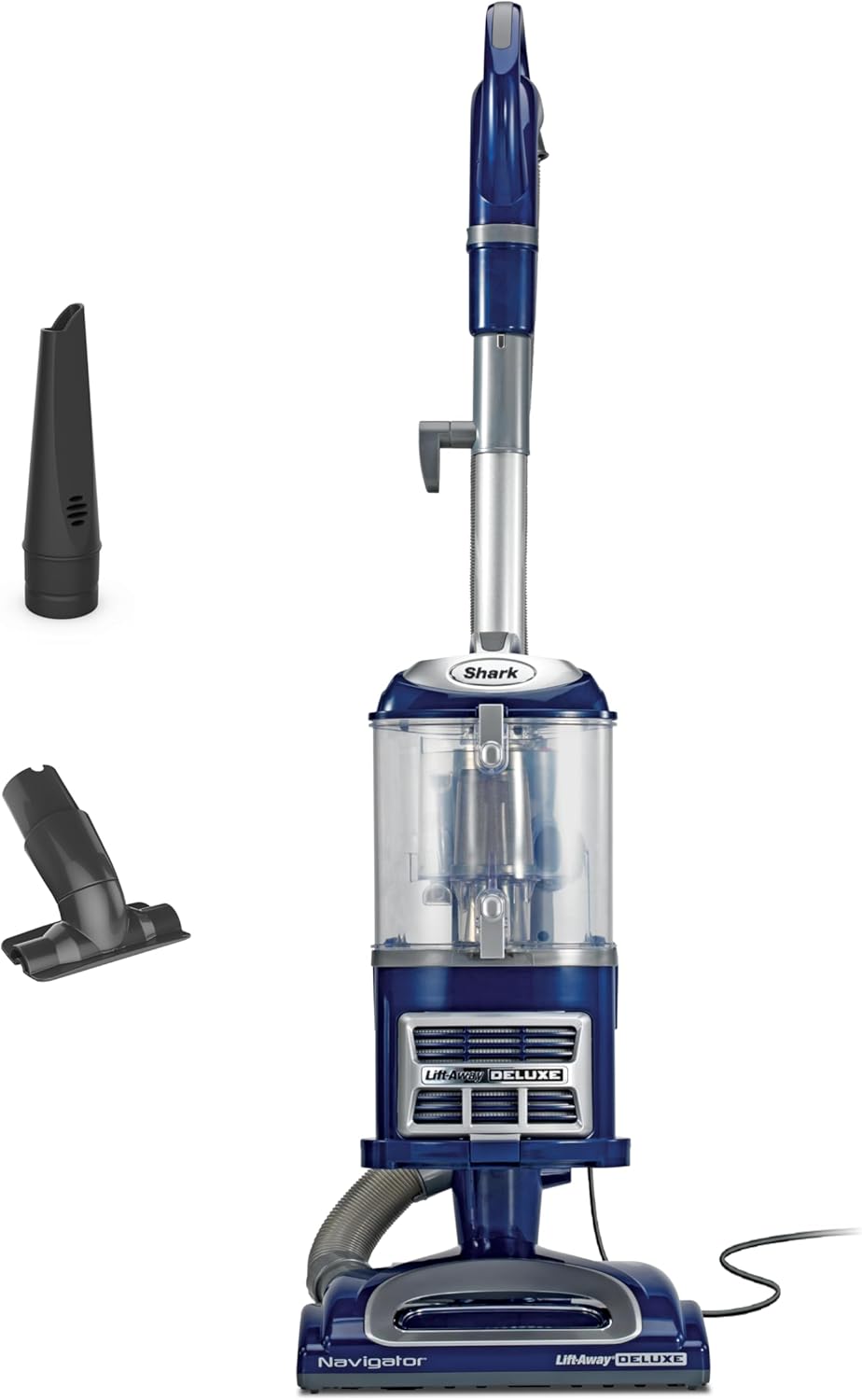
Diving beneath the hood reveals stark engineering differences that dictate how these machines handle daily grime. Consider physical scale: a typical Robot Vacuum stands a mere 3.5 inches tall to slide effortlessly underneath low sofas, whereas an Upright Vacuum commands a bulky 45-inch vertical profile built around a heavy motor assembly and a massive cyclonic dust cup. Power delivery also splits these rivals down the middle. While your typical Robot Vacuum relies on a rechargeable lithium-ion battery pack lasting roughly 90 minutes before limping back to its dock, the Upright Vacuum plugs directly into the wall for unlimited runtime backed by a roaring 12-amp motor.
✓ = better value in that row. Sourced from manufacturer specifications.
Robot Vacuum vs Upright Vacuum: Performance & Category Ratings
When you break down the numbers, the battleground shifts rapidly depending on what you value most. Cleaning Performance belongs decisively to the Upright Vacuum, which pulls a commanding 9.3 rating thanks to deep-reaching brush rolls and intense suction that tears stubborn pet hair from dense carpets. The Robot Vacuum manages a respectable 7.4 here, perfectly fine for light daily dust on hard floors, but it simply lacks the raw airflow required for heavy-duty restoration. Value follows a similar trajectory; the Upright Vacuum scores an 8.8 because you get raw mechanical durability and zero battery degradation headaches over a decade of use, whereas the Robot Vacuum sits at a 7.0 due to high replacement costs for consumable filters and declining battery health. Reliability heavily favors the manual machine as well, netting a 9.1 for the Upright Vacuum against a 7.2 for the Robot Vacuum, which frequently gets stuck on loose charging cables or rugs.
Tables completely turn once you examine the lifestyle metrics. Convenience is where the Robot Vacuum obliterates the competition, commanding a massive 9.6 rating because it vacuums your floors while you are literally asleep or at the office. The Upright Vacuum lags far behind at a 6.2 in convenience, demanding your physical labor, manual cord winding, and constant bag adjustments. Features also heavily tilt toward automation, with the Robot Vacuum scoring a 9.2 thanks to LiDAR room mapping, smartphone app geofencing, and automatic dirt disposal bases. The Upright Vacuum hits a modest 6.5 here, offering basic height adjustments and maybe an LED headlight, but little in the way of smart software. Build Quality closes the gap, though the Upright Vacuum still edges ahead with an 8.5 against the Robot Vacuum’s 7.8, reflecting heavier plastics and more robust mechanical joints.
Robot Vacuum
Upright Vacuum
Robot Vacuum Vs Upright Vacuum by the Numbers
Raw ratings provide a great foundation, but quantitative metrics lay bare the stark operational differences between autonomous cleaning and manual muscle. Reviewing decibel outputs, dustbin capacities, and weight distributions helps clarify why these two machines occupy entirely different universes of home maintenance. Let us examine the hard data.
Robot Vacuum
Upright Vacuum
Hover any bar for exact values. Each metric scaled independently.
Robot Vacuum: Strengths and Weaknesses
Embracing a Robot Vacuum fundamentally changes how you maintain a clean home. Its greatest superpower is consistent, friction-free habit formation; you schedule it to run every Tuesday and Friday at 10 AM, and you completely forget about surface dust. LIDAR navigation maps your floor plan with astonishing precision, allowing you to draw virtual no-go zones around pet bowls or delicate vase stands. The integration of smartphone apps and automated self-emptying bins means you might only interact with the machine twice a month. To keep your automated cleaner running smoothly without clogging its intake ports, we strongly recommend using a can of 🛒 Compressed Air Duster → to clear out the cliff sensors and charging contacts every few weeks.
Yet, the limitations of these automated discs are impossible to ignore. Low-profile engineering means tiny dustbins that require constant attention if you have shedding pets. High-pile carpets turn into impassable mountain ranges where these units frequently beach themselves, flashing red error lights until you come to their rescue. Suction is inherently limited by battery constraints, meaning embedded grit remains untouched unless you run max-power modes that drain the battery in under twenty minutes. It is a maintenance tool, not a deep-cleaning machine. Grab your wallet and check out the latest automated pricing to see if daily hands-off sweeping justifies the performance compromise.
Price & availability subject to change. As an Amazon Associate we earn from qualifying purchases.
Upright Vacuum: Strengths and Weaknesses
Pulling an Upright Vacuum out of the closet feels like bringing out the heavy artillery. The suction performance is simply in a different league, pulling deeply embedded pet dander, sand, and fine silt from the absolute base of thick living room carpets. You get a massive multi-liter dust cup or bag that rarely needs emptying mid-session, combined with zero battery anxiety thanks to a generous 30-foot power cord. Multi-cyclonic separation ensures suction never drops, even as the bin fills to the brim. When dealing with stray pet hair embedded deep in upholstery or stairs, snapping on an 🛒 Upholstery Turbo Brush Attachment → makes quick work of messes that would choke smaller vacuums.
Manual labor is the unavoidable tax you pay for this incredible cleaning power. Dragging a 16-pound machine up a flight of stairs tests your patience and your lower back. You must manually unwind the cord, dodge furniture legs, and physically push the heavy housing across every square inch of your home. Storage footprint is another headache; these upright titans demand a dedicated corner of a hall closet. Despite these physical demands, the sheer cleaning output makes it an indispensable tool for heavy-duty household upkeep. Review the current retail deals below to secure a machine that will easily outlast any battery-powered competitor.
Price & availability subject to change. As an Amazon Associate we earn from qualifying purchases.
- ✅ Operates completely autonomously on schedules
- ✅ Cleans under low-profile furniture effortlessly
- ✅ Advanced mapping avoids cords and pet waste
- ✅ Self-emptying docking stations reduce upkeep
- ❌ Significantly more expensive upfront
- ❌ Struggles with deep-pile carpet embedded dirt
- ❌ Battery degrades over 3 to 5 years
- ✅ Unmatched deep cleaning suction on carpets
- ✅ Larger dust bin holds significantly more debris
- ✅ No battery limits or charging wait times
- ✅ Longer expected lifespan with fewer electronic failure points
- ❌ Requires manual labor and physical pushing
- ❌ Bulky frame is difficult to store and carry upstairs
- ❌ Tangled brushrolls require frequent manual hair removal
Robot Vacuum or Upright Vacuum: Which Should You Choose?
Your living situation dictates your winner far more than any spec sheet. If you live in a modern apartment dominated by smooth hardwood floors and low-profile area rugs, buying a Robot Vacuum completely eliminates sweeping chores from your weekly mental load. Busy professionals and remote workers who despise routine physical chores will find the automated scheduling life-changing. You let the bot handle the daily surface maintenance, and your floors always look presentable without lifting a finger.
Conversely, if your home features wall-to-wall high-pile carpeting, multiple shedding Golden Retrievers, or kids tracking in mud daily, an Upright Vacuum is non-negotiable. Budget-conscious buyers should also note that a great manual upright costs half the price of a reliable mapping robot while delivering double the lifespan and zero battery replacement costs. Power users who demand pristine, allergen-free deep-cleaned carpets cannot rely on a tiny robotic motor. For households fighting severe dust allergies, pairing your main cleaner with an 🛒 HEPA Air Purifier → in the bedroom will capture airborne particulates that any vacuum naturally stirs up during operation.
Busy homeowners wanting daily automated surface dust management.
Homes with thick carpets, pets, and heavy-duty cleaning needs.
Final Verdict: Robot Vacuum vs Upright Vacuum
The Upright Vacuum remains the ultimate choice for deep carpet restoration and heavy debris, while the Robot Vacuum wins on daily convenience and time savings. For most modern homes, pairing an automated helper for routine maintenance with a manual upright for deep cleans is ideal, but if you must choose one, Upright Vacuums win on sheer performance. You are trading pure cleaning power and long-term durability for effortless, scheduled automation.
As an Amazon Associate we earn from qualifying purchases.
Robot Vacuum vs Upright Vacuum: Frequently Asked Questions
Is Robot Vacuum better than Upright Vacuum?
Not for deep cleaning. While Robot Vacuums offer superior convenience with 120-minute runtimes and automated schedules, Upright Vacuums deliver triple the suction power and extract 95 percent of embedded carpet dirt that robots leave behind.
Which option is more reliable over time?
Upright Vacuums are vastly more reliable, typically lasting 7 to 10 years with basic maintenance. Robot Vacuums feature complex LiDAR sensors, motherboards, and lithium-ion batteries that usually require replacement or repair within 3 to 5 years.
Can a Robot Vacuum completely replace an Upright Vacuum?
For homes with mostly hard floors and low-pile rugs, yes. However, homes with thick carpets, shedding pets, and heavy upholstery will still need an Upright Vacuum for periodic deep cleaning sessions.
Which vacuum is better for pet owners?
It depends on the mess. Upright Vacuums handle heavy hair accumulation across thick carpets much better, though high-end Robot Vacuums with anti-tangle brushes excel at daily pet hair maintenance on hard floors.
What is the biggest difference in operating costs?
Robot Vacuums incur higher ongoing costs averaging $45 annually for replacement HEPA filters, side brushes, and disposable dust bags, compared to just $15 per year for manual upright filter replacements.